
Insights
Mindset Shift: Need of the hour for Indian OOH
Writing a sharp column for the August edition of Outdoor Asia Pramod Bhandula, Executive Chairman – JCDecaux India, talks about how the path forward for Indian OOH industry lies in ownership of regulatory conversation, demonstrating serious governance to draw investments, and in associations stepping up as educators.

The story of Out-of-Home advertising is, at its core, a story of reinvention. Prior to the digital age, meticulously hand-painted billboards were the norm. Beginning in the 1990s, computer-printed materials became the standard — a watershed moment that rewired the economics and aesthetics of the medium overnight. The early 2000s then ushered in the era of LED technology — not just a step up from painted or vinyl-wrapped ads, but a giant leap forward.
Digital displays were launched in the early 2010s in major markets, and where billboards once had to be manually changed, digital displays offered the ability to switch content within seconds. The industry never looked back.
That same transformative energy is now building again — only this time, it is programmatic, data-driven, and algorithmically intelligent. And the question facing Indian OOH leaders today is stark: will we lead this wave or watch it wash past us? The global benchmark we must confront The contrast between India and mature OOH markets is not a minor gap — it is a chasm. The United States recorded OOH revenues of USD 9.1 billion in 2024, the highest in its history, with roughly one-third already coming from digital formats. China’s outdoor ad spends exceeded USD 23 billion in 2023, with transit and digital screens across high-density urban centres as the key growth levers. The UK recorded outdoor ad revenues of £1.4 billion in 2024, with digital OOH accounting for 66 percent of that total. (Industry Sources) India, by comparison, grew its OOH segment by 12% in 2024, reaching INR 4,650 crore (Pitch Madison) — an all-time high. Impressive momentum, yes. But here is the sobering reality: DOOH revenues in India reached INR 558 crore in 2024, contributing just about 12% of total OOH revenues. Against the UK’s 66% digital share or America’s one-third, India remains heavily static in a world racing toward dynamic.
Fragmentation: Our self-inflicted wound
Why does this gap persist? The honest answer is that it is partly structural and partly a failure of collective will. OOH advertising in India is governed by a patchwork of municipal laws, with non-uniform permit regimes and frequent policy reversals. Thousands of local vendors operate inconsistently formatted inventory, making national campaigns difficult to scale or measure. Talent gaps and governance deficits compound the problem. Of the approximately 185,000 active DOOH screens across around 50 Indian cities, 75% are concentrated in the top 12 metro cities. We are building an island of digital progress in a sea of unregulated static clutter.
The path forward requires industry leaders to stop waiting for conditions to improve and start creating those conditions themselves.
The mindset shift: Three imperatives
First, we must take ownership of the regulatory conversation. Municipal administrators and city planners are not adversaries – they are partners who have not yet been convinced. The OOH industry is not merely an advertising medium; it is a component of urban identity and skyline design. When OOH operators present themselves as partners in city beautification and smart infrastructure – not just billboard vendors seeking permits — the conversation changes entirely.
Second, industry associations must step up as genuine educators. The role of bodies like IOAA goes well beyond annual summits. Educating principals, creating measurement standards, and lobbying for unified national frameworks are mission-critical functions, not nice-to-haves. For India to move closer to global parity, cohesive action between regulators, industry bodies, and private operators is essential – with unified audience metrics, transparent pricing, and nationwide programmatic adoption.
Third, the industry must attract serious investment by demonstrating serious governance. Financial institutions do not fund fragmented, unregulated markets. India’s digital OOH market is bound to grow substantially, that growth story is compelling – but only if the industry can show sustainability, accountability, and measurable ROI that institutional capital requires.
he prize that awaits
Globally, DOOH’s share in OOH ad revenues surpassed 40 percent in 2024 and is expected to continue rising through the decade. Programmatic OOH — where campaigns are bought, optimized, and measured in real time — is rapidly becoming the global standard. More than 70% of DOOH spend in North America is already transacted programmatically. India is not there yet, but DOOH’s share of Indian OOH revenues is projected to reach 17% by 2027, growing at a CAGR of 24%.
The bones of an extraordinary industry are already here — the infrastructure buildout, the metro corridors, bullet trains, the young urban population. What is missing is not opportunity. It is urgency. It is the willingness of serious players to align, to standardize, to invest in measurement, and to collectively tell a story that regulators, city administrators, and financial institutions can believe in.
The digital tech driven programmatic future of OOH is not a distant dream -it’s arriving now. The only question is whether Indian OOH will be its architect or its latecomer.
The window is open. Let us not be the generation that lets it close.






Daily Newsletter
Subscribe to receive the latest OOH
industry updates

Vistar Media expands operations in Japan

Landsec and Ocean Outdoor build on the cultural resonance of Piccadilly Lights

Century Business Media announces SME IPO, eyes expansion across OOH segments

A reality check on the OOH industry by Noomi Mehta

Trip.com turns Dhoby Ghaut MRT into a personal travel story

Puma becomes PVMA for PV Sindhu

HOCCO’s Aamchi campaign brings mango tree to Ahmedabad

Blinkit in association with Kinetic India goes all Bollywood

Acclaimed Actor Manoj Joshi to deliver an inspirational address at OAC 2024

Zepto’s Fast 10 Minute Delivery Saves the Day for Game Night in Ahmedabad!

‘Let’s create an empathetic space for women’

‘It won’t just be a man’s world anymore’

‘We’re actively exploring acquisitions and working to increase our inventory’

A habit of success at Prakash Arts

‘OOH is an important channel to connect with corporate audiences’

Sales Manager (Amritsar, J&K, Chandigarh, Mumbai, Vadodara, Udaipur, U.P.)
Orango has been involved in creating, building, reviving and growing brands. Orango builds powerful connections with their customers & people...

Sales Executive
Established B2B Media and Events Group VJ Media Works is looking for sales executives
Digital Marketing/Social Media Executives
Established B2B Media and Events Group VJ Media Works is looking for the following: Digital Marketing/Social Media Executives Location: Mumbai/Bangalore...

Sales Manager – AdZ (Digital Advertising)
Estontec Group’s fast-growing adtech brand AdZ is hiring a Sales Manager to drive digital media sales and client growth. This...
Onboarding Specialist
Join Estontec Group’s transit media brand BrandonWheelz as an Onboarding Specialist, managing campaign execution, vendor coordination, and media planning across...

Operation Manager
Company Description: BajuGali an Advertisement Company is a leading firm specializing in advertising and marketing services. We provide innovative solutions...


Senior Copy Editor
No of openings: 1 Experience/ qualifications: 3-4 years in any media/news publication Graduate Degree in any discipline, degree in Journalism...

Sales Specialist at BajuGali (OOH Advertising Company)
At BajuGali, we are a marketing and advertising agency that specializes in transforming creative visions into reality for brands and...
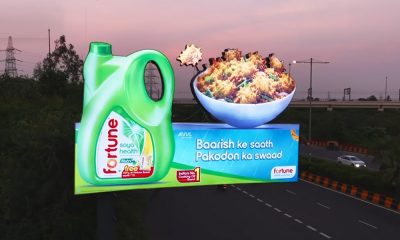

Fortune Soya Health brings ‘Baarish Ke Saath Pakodon Ka Swaad’ to the streets
The OOH innovations are conceptualised and executed across Delhi, Lucknow and Patna by Coral Media
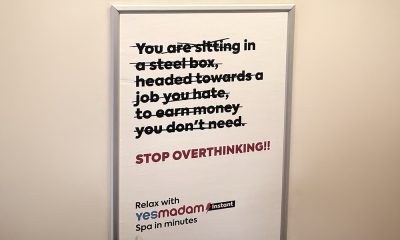

YesMadam turns Delhi Metro into a reminder to ‘Stop Overthinking’
With a series of sharply relatable messages placed inside Delhi Metro coaches, YesMadam uses everyday anxieties around work, money, relationships...


Netflix takes ‘The Gentlemen’ outdoors – and puts its message on the grass
For Season 2 of Netflix’s The Gentlemen, a field near the Gatwick flight path became an unexpected OOH canvas, with...
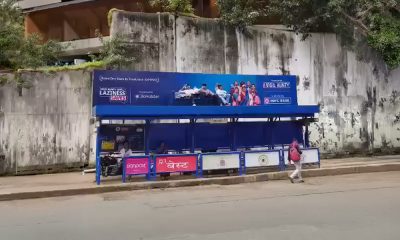

HDFC Bank turns a bus shelter into a lesson in fraud awareness
With its latest Vigil Aunty campaign, HDFC Bank uses a familiar public space and a playful visual to bring its...
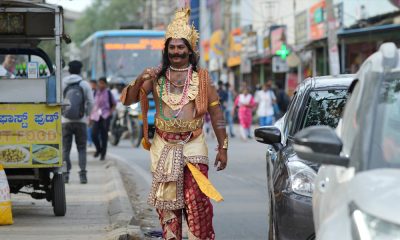

Ghatotkacha takes over Bengaluru to announce Vivaha Bhojanambu
Conceptualised by Mark Creative Agency, the campaign used a Telugu cultural icon to create curiosity around the brand’s launch in...


Royal Stag Boombox goes larger-than-life with anamorphic LED in Hyderabad
The campaign is conceptualised and executed by Coral Media
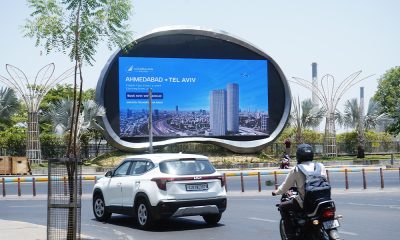

Times OOH Unveils ‘The Riviera’ in Ahmedabad
The screen is located at Sabarmati Riverfront on Ashram Road
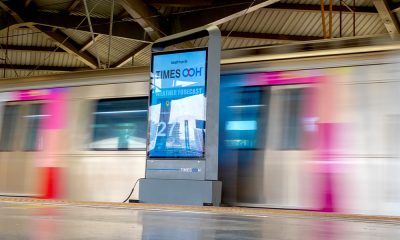

Times OOH upgrades the Media Experience on Mumbai Metro Line 1
The move to 75-inch displays gives brand creatives significantly greater visual impact, while the enhanced brightness ensures vivid, true-to-life imagery...

Broadsign released 2026 programmatic DOOH trends report
Drawing on full-year 2025 and Q1 2026 internal transaction data, the report, surfaces useful signals about what today’s buyers value...
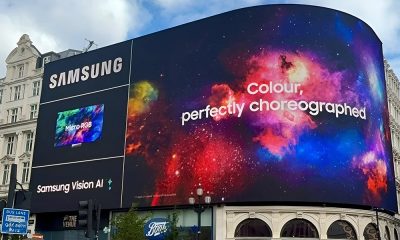

Samsung lights up global landmarks with Micro RGB OOH campaign
The consumer electronics giant has rolled out a large-scale global OOH campaign across some of the world's most iconic digital...
-
 Campaigns
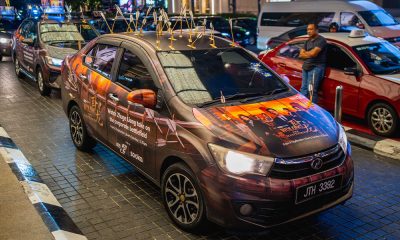
Wolong: The Mastermind takes its story from the road to the screen in Malaysia
-
Campaigns
Netflix takes ‘The Gentlemen’ outdoors – and puts its message on the grass
-
Campaigns
HDFC Bank turns a bus shelter into a lesson in fraud awareness
-

 Insights
“Mere certification and parameters won’t fix it’