
Insights
Why the real culprit is not reverse auction, but how it is used
Next in the series of reverse bidding, Vaishal Dalal, Co-founder & Director, Excellent Publicity, shares his views on the growing pressure on premium inventory valuation, the need for value-led media planning, and why the industry must protect quality, innovation, and long-term ecosystem sustainability.


The conversation around reverse auctioning in the Out-of-Home industry is important, but it needs to be viewed with balance. Reverse auctioning, by itself, is not the problem. In fact, transparent and structured buying mechanisms can bring efficiency, speed and accountability to media planning. The concern begins when the process starts treating every OOH asset as interchangeable and reduces the medium to only one metric: the lowest price.
The collective impact on eco-system
OOH has never been a purely commodity-led medium. A hoarding at a high-traffic junction, a premium airport site, a metro wrap, a mall media unit or a contextual digital screen cannot be evaluated only by square footage or CPM. Each asset carries a different value depending on location, audience profile, dwell time, visibility, exclusivity, creative possibility, maintenance quality and execution reliability. When these differences are ignored, reverse auctioning can create pricing pressure that affects not just media owners, but the overall quality and sustainability of the ecosystem.
The biggest risk is that premium inventory may start getting benchmarked against non-premium inventory. This can weaken pricing discipline in the market. Media owners invest significantly in acquiring locations, maintaining assets, upgrading digital infrastructure, ensuring compliance and enabling innovation. If buying decisions are driven only by the lowest bid, it becomes harder for them to justify long-term investments in better sites, better technology and better campaign delivery.
There is also a relationship angle that cannot be ignored. The OOH industry is built on collaboration between brands, agencies, specialist partners and media owners. When procurement-led processes put excessive downward pressure on pricing, it can strain these relationships. Media owners may feel squeezed, agencies may have limited room to defend strategic planning, and brands may not always get the best execution outcome. A campaign that looks efficient on paper may lose impact if the selected inventory lacks relevance, maintenance quality or contextual strength.
Price-led buying Vs value-led buying
It would however be unfair to say that reverse auctioning has completely commoditised OOH. The market is evolving, especially with the growth of digital OOH and programmatic buying. Globally,
premium inventory is still being protected through private marketplaces, guaranteed deals, curated buying models and better measurement frameworks. This shows that the industry is not rejecting automation. Rather, it is trying to build more disciplined ways of using automation without compromising value.
The real distinction should be between price-led buying and value-led buying. Price-led buying asks, “What is the cheapest way to buy this inventory?” Value-led buying asks, “Which inventory will deliver the right audience, visibility, context and outcome for the brand?” OOH works best when the second question is given more importance.
What happens to innovation?
Innovation is another area that can be affected. Some of the best OOH campaigns today involve 3D installations, anamorphic creatives, transit innovations, dynamic digital creatives, contextual triggers, hyperlocal targeting and integrated amplification. These ideas need planning time, skilled execution and investment. If the industry is pushed too strongly into lowest-cost selection, innovation naturally takes a back seat. The medium then risks being used only as a visibility channel, instead of a high-impact brand experience platform.
This is especially important at a time when OOH is becoming more measurable. With digital screens, mobility data, audience estimation, proof of play, campaign tracking and attribution models, the medium is moving closer to outcome-based evaluation. This progress should not be reduced to simple cost comparison. A higher-priced site may still be the better buy if it delivers stronger attention, better audience relevance, higher recall or stronger business outcomes.
Future lies in a judicious approach that protects value
The way forward is not to remove reverse auctioning completely, but to define where and how it should be used. For flexible, tactical or non-premium inventory, auction-led buying can help unlock efficiency. But for premium, scarce, strategic or innovation-led inventory, the industry needs stronger value-based frameworks. These should consider location quality, audience relevance, execution standards, visibility, campaign objective, measurement and brand safety.
Brands also need to look at OOH as a medium of attention, trust and real-world presence. A billboard, a transit wrap or a digital screen is not just an impression. It occupies public space, influences perception and creates familiarity in the consumer’s physical environment. This value cannot be captured only through lowest-cost buying.
The future of OOH should be built on transparency, not price compression. Buyers should know what they are paying for. Media owners should have pricing control and fair visibility. Agencies should be able to defend strategic value. Brands should be able to compare media options not just on cost, but on the quality of exposure and the strength of expected impact.
Reverse auctioning has brought an important conversation to the surface. It has reminded the industry that efficiency matters, but it has also shown why value must be protected. For OOH to grow sustainably, the market must move from “lowest price wins” to “right value wins.”
That is where the future of the medium lies: not in treating every site as the same, but in recognising that the strength of OOH comes from location, context, creativity, execution and measurable impact working together.



Daily Newsletter
Subscribe to receive the latest OOH
industry updates

Traya marks Dussehra with ‘Andhere Mein Teer Mat Chalao’ activation

Trident Group brings ‘Tree of Strength’ to Durga Puja with a sustainability-led activation in Kolkata

KISNA takes festive gifting nationwide with 300+ billboards featuring Shahid and Mira Kapoor

Dr. Falguni Vasavada, Professor of Marketing at MICA, to speak at Gujarat Talks OOH

Rohit Chopra of Times OOH joins Gujarat Talks OOH panel on infrastructure-led growth

Puma becomes PVMA for PV Sindhu

HOCCO’s Aamchi campaign brings mango tree to Ahmedabad

District uses Samay Raina’s signature shirt to announce his live show

Blinkit in association with Kinetic India goes all Bollywood

Acclaimed Actor Manoj Joshi to deliver an inspirational address at OAC 2024

‘Let’s create an empathetic space for women’

‘It won’t just be a man’s world anymore’

‘We’re actively exploring acquisitions and working to increase our inventory’

A habit of success at Prakash Arts

‘OOH is an important channel to connect with corporate audiences’

Video Editor
Job Description: Editing videos of editorial interviews, in-house events, video podcasts, promotional videos and others based on team brief Planning...
Content Editor-Writer
Job Description: Editing daily news copies and magazine articles Writing industry research and interview based articles and client focused content...


Sales Manager (Amritsar, J&K, Chandigarh, Mumbai, Vadodara, Udaipur, U.P.)
Orango has been involved in creating, building, reviving and growing brands. Orango builds powerful connections with their customers & people...

Sales Executive
Established B2B Media and Events Group VJ Media Works is looking for sales executives
Digital Marketing/Social Media Executives
Established B2B Media and Events Group VJ Media Works is looking for the following: Digital Marketing/Social Media Executives Location: Mumbai/Bangalore...


Sales Manager – AdZ (Digital Advertising)
Estontec Group’s fast-growing adtech brand AdZ is hiring a Sales Manager to drive digital media sales and client growth. This...
Onboarding Specialist
Join Estontec Group’s transit media brand BrandonWheelz as an Onboarding Specialist, managing campaign execution, vendor coordination, and media planning across...


Operation Manager
Company Description: BajuGali an Advertisement Company is a leading firm specializing in advertising and marketing services. We provide innovative solutions...


Kolonkojoyini uses Maa Durga installation to highlight stigma faced by trafficking survivors
The installation was conceptualised and brought to life by Tribes in collaboration with Sanlaap.
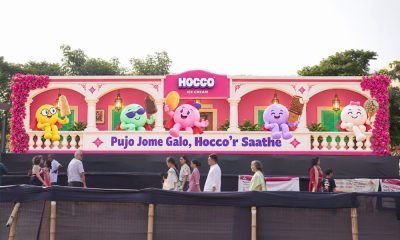

Hocco brings its East India debut to Kolkata streets with a pujo-themed campaign
To give the campaign a local feel and connect with people during Pujo, the brand used regional-language hoardings in Bengali.
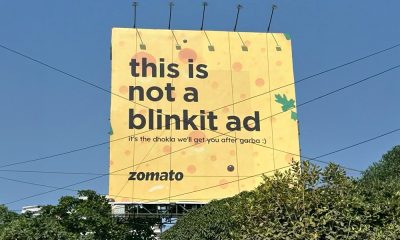

Zomato serves up a Garba-inspired OOH twist with a ‘not a Blinkit ad’ billboard
The billboard plays on Blinkit’s brand identity to promise a familiar Gujarati treat after Garba, using local food culture and...
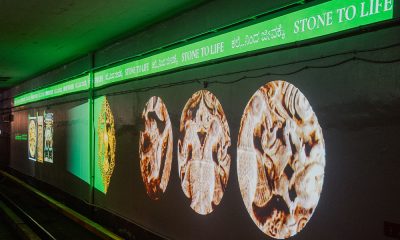

Signpost India turns Bengaluru Metro into a canvas for Karnataka’s cultural heritage
The 16,000 sq. ft. visual experience brings Karnataka’s mythical forms and cultural heritage to life through advanced 8K Japanese projection...


Paramount Pictures takes ‘Street Fighter’ from street signs to larger-than-life OOH stunts
From fight-inspired street signage to a billboard featuring a larger-than-life stunt, Paramount Pictures turns the streets into an extension of...
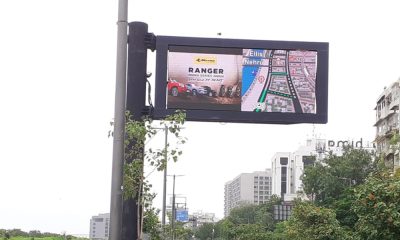

WOW Advertisement adds eight digital OOH screens across Ahmedabad and Surat
The expansion includes seven traffic LED screens across Ahmedabad and a 41 ft × 60 ft curved outdoor LED screen...
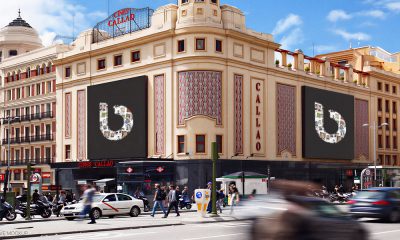

billups celebrates its anniversary by putting its people on billboard
The campaign is participating in fifteen locations across Asia, Europe and North America, including Belgrade, Amsterdam, Brussels, Berlin, Chicago. Portland,...
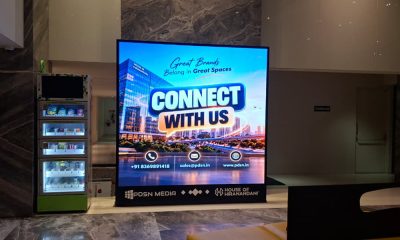

PDSN Media expands corporate DOOH network with new screens at Fulcrum
The new inventory comprises two 8×8 ft digital LED screens installed across Wing A and Wing B of the Mumbai...
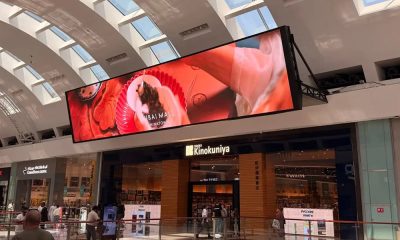

Dubai Mall expands its DOOH network with 1,100 sqm of LED displays
Emaar Properties has reportedly deployed approximately 1,100 sq m of LED displays across indoor and outdoor areas of Dubai Mall,...


Broadsign bags contract with Context Networks for screen network in 14 US states
Through the collaboration, Context Networks is connecting eligible CPMN™ inventory to the Broadsign Platform, the company’s complete, reliable Ad Server...
-
Campaigns
Zomato serves up a Garba-inspired OOH twist with a ‘not a Blinkit ad’ billboard
-
Creative Concepts
Signpost India turns Bengaluru Metro into a canvas for Karnataka’s cultural heritage
-

 Contracts & Investments
TVS Motor appoints Dentsu for integrated media mandate
-
 Industry News
US study finds OOH delivers $7.97 in marginal profit ROI as DOOH adoption triples