
Insights
Why we need to move towards unified data architecture & more
In this piece, first published in August 2026 edition of Outdoor Asia, Junaid Shaikh, Managing Director, Roshanspace Brandcom, calls out the urgent issues to be addressed for the OOH industry to grow.

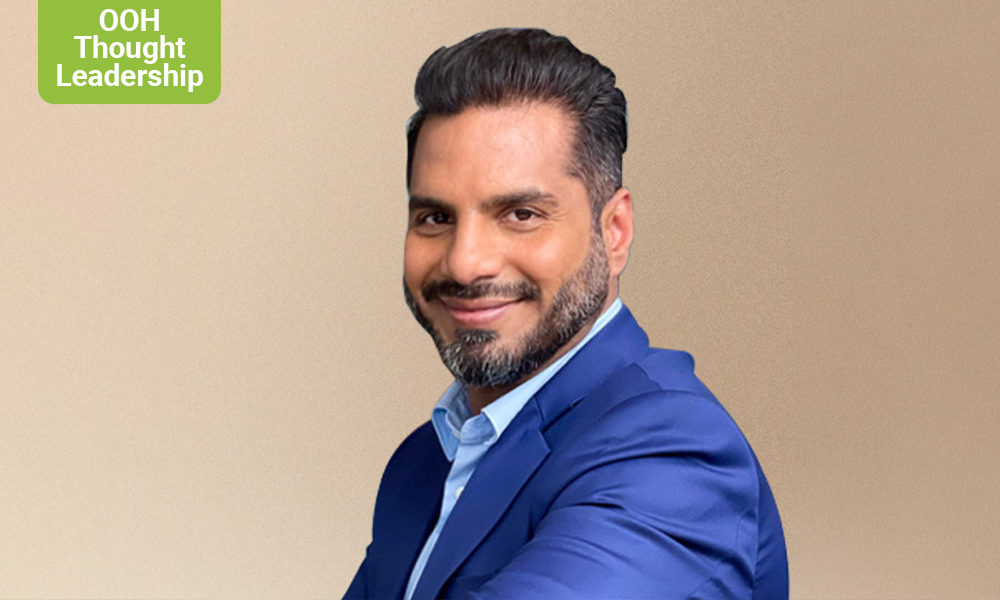
India’s DOOH story is an opportunity waiting to be explored. India’s OOH ad market is vast, valued at over ₹6,500 crore and growing at 10-15% annually, set to hit ₹7,900 crore by 2027. But OOH’s fastest-growing segment, with a stellar 24% CAGR, is DOOH. It is predicted to jump from a 12% to a 17% share of the OOH pie by 2027. Yet, the question that looms large is: Is the medium following the right trajectory, and is there a broad roadmap for the growth that can be eventually explored? And the fact that if there was one the growth would have been in line with those of the mature DOOH markets.These figures are compelling, but the uncomfortable truth: growth without measurability/ unified currency is merely borrowed time. If we cannot prove the real value of DOOH in terms that matter to CFOs, media buyers, and brand managers alike, we will waste the next decade begging for budgets instead of earning them.
Why Measurement?
In client conversations, my clients are yet to demand impression and impressions led reports, this distinction is crucial. An impression count is a media company’s statement; verified, third-party-audited proof-of-play data assuring legitimate media buy. The chasm here emanates from the fact that difference between DOOH and STATIC is not clear, currently DOOH is a STATIC asset enhanced with a screen and nothing more!
Measurement is vital for three reasons. First, client trust – premium brands will not allocate significant funds to a medium they cannot hold accountable. Apple’s primary question upon entering the ProDigi network wasn’t about location or scale, but verification. Could we prove their creative ran exactly where and when scheduled?
Our Broadsign-powered proof-of-play answered it with a resounding yes. Second, ROAS brands need to demonstrate the return on every rupee spent. DOOH that can link exposure to brand recall and these are conversations we need to have which emanate from traffic counts/ data etc but definitely not limited to it- because Outdoor Media delivers impact liek none other and there needs to be certain impact premium attahed to the medium. Third, and most importantly for the industry’s long-term sustainability, measurability elevates DOOH from a line item in the outdoor budget to a serious component of the overall media plan and shall definitely bring in sanctity to the process.
At RoshanSpace, we committed to this early. We have incorporate live, in-field audience measurement at the asset level, capturing real-time commuter data. Our ProDigi network operates on Broadsign CMS, providing robust scheduling, proof-of-play verification, and the programmatic capabilities demanded by performance-driven advertisers. Our Dynamic Creative Optimisation and Replacement for a Wimbledon campaign, dynamically altering creative based on match results and player progress, was a tangible demonstration of DOOH’s potential as a performance medium. Much earlier we had built DeSync CMS Tech- it was built to do something more ambitious: run differentiated creative simultaneously across series of screens, so a brand can speak to thier consumers with multiple messages, multiple products, or multiple audience moments within a single commuter’s field of vision. It is the difference between a billboard and a content environment. The industry gave it its top honour for DOOH storytelling innovation. The brands that have used it like Zepto, NIC Ice Cream, Birla Opus and others, understood immediately why. This journey of creating unprecedented innovations actually began in the year 2023, where DeSync separates, Screen Sync unifies, synchronised playback across multiple sequential ProDigi TWINN screens, so a brand narrative unfolds across a corridor between mammoth screens. So the endeavor has been that when a commuter is driving through the WEH or EEH, he/ she does not see one ad repeated. They move through a story. It was the first deployment of its kind on a roadside DOOH network.
Measurability
The industry has traditionally focused on the wrong measures, or at least, measured the right things inadequately. Footfall counts and impressions data are merely starting points. Serious advertisers require metrics such as dwell time, audience composition, verified play logs, and most critically, attribution, cohorts- the ability to connect OOH exposure to a downstream consumer action.
The fundamental shift required in our industry is from a disparate, operator-specific measurement landscape to a unified data architecture. Currently, a brand buying from five different DOOH operators in Mumbai is receiving five distinct impression methodologies, audience definitions, and proof-of-play reports. This is not a media plan; it is a mosaic of incomplete information, a major reason why DOOH’s share of India’s total media investment is significantly lower than in the US @36-40% and China even better and these are countries that proactively embraced standardized measurement. Our ProDigi Flagpoles for example deliver an average of 3.8 to 4 million verified impressions daily with an average dwell time of 7.6 seconds per exposure. This 7.6 seconds is not an estimate; it’s a product of deliberate site selection and strategic placement- the kind of figure that instantly reconfigures a brand manager’s perspective on unmeasurable DOOH.
Industry Bodies
Let me be honest, the industry body’s primary role right now isn’t lobbying for less regulation or more screens. It’s defining and implementing a common measurement currency for DOOH, enforcing its adoption across the sector. Standardized adn evolved metrics are crucial for increasing accountability and ad spend, but standardisation comes from an industry body setting the standard, providing the verification tools, and making compliance a requirement for legitimacy. Indian OOH needs a Nielsen equivalent immedaitely, before advertisers and agencies develop their own fragmented solutions. A common measurement framework benefits everyone, especially those investing in quality, behind structurally sound, premium assets. Currently, the market can’t make that distinction.
Navigating Regulation
The regulatory framework represents a significant hurdle for India’s DOOH growth. Many cities impose strict outdoor advertising rules, limiting video content on screens due to concerns about driver distraction, sustainability and energy use. Ironically, the operators most affected by these regulations, those who have invested heavily in safety and compliance, are being hindered by a framework or the lack of it, that does not address the gap or the immediate need of bringing in process for the industry. We have actively engaged in these discusssions. We have questioned authorities over opaque licensing and the BMC on hoarding distance and structural compliance policies. We believe a regulatory framework that distinguishes between premium, certified compliant operators and unregulated installations is much needed… We should refuse to let the industry be defined by its lowest common denominator. The undeniable lesson is that you cannot navigate regulation alone; a unified, evidence-based industry voice is essential. Media owners who prioritize quality have the strongest argument, and they must present it together.
The future of Indian DOOH hinges on measurability, programmability, and accountability. The technology and market appetite are here; it’s time for the industry to align with the standards its growth trajectory demands. We have to integrate standards into every aspect of our business before advertisers’ patience runs out.






Daily Newsletter
Subscribe to receive the latest OOH
industry updates

Mangalam brings #BreatheBhimseni experience at Lalbaugcha Raja

Broadsign bags contract with Context Networks for screen network in 14 US states

iPhone 18 Pro takes over a billboard in Surat

Hero Destini brings ‘The Dragon’s Test’ to life through 3D anamorphic DOOH

Indian pDOOH: A SWOT Analysis & Path Forward

Puma becomes PVMA for PV Sindhu

HOCCO’s Aamchi campaign brings mango tree to Ahmedabad

Blinkit in association with Kinetic India goes all Bollywood

Acclaimed Actor Manoj Joshi to deliver an inspirational address at OAC 2024

Zepto’s Fast 10 Minute Delivery Saves the Day for Game Night in Ahmedabad!

‘Let’s create an empathetic space for women’

‘It won’t just be a man’s world anymore’

‘We’re actively exploring acquisitions and working to increase our inventory’

A habit of success at Prakash Arts

‘OOH is an important channel to connect with corporate audiences’

Video Editor
Job Description: Editing videos of editorial interviews, in-house events, video podcasts, promotional videos and others based on team brief Planning...
Content Editor-Writer
Job Description: Editing daily news copies and magazine articles Writing industry research and interview based articles and client focused content...


Sales Manager (Amritsar, J&K, Chandigarh, Mumbai, Vadodara, Udaipur, U.P.)
Orango has been involved in creating, building, reviving and growing brands. Orango builds powerful connections with their customers & people...

Sales Executive
Established B2B Media and Events Group VJ Media Works is looking for sales executives
Digital Marketing/Social Media Executives
Established B2B Media and Events Group VJ Media Works is looking for the following: Digital Marketing/Social Media Executives Location: Mumbai/Bangalore...


Sales Manager – AdZ (Digital Advertising)
Estontec Group’s fast-growing adtech brand AdZ is hiring a Sales Manager to drive digital media sales and client growth. This...
Onboarding Specialist
Join Estontec Group’s transit media brand BrandonWheelz as an Onboarding Specialist, managing campaign execution, vendor coordination, and media planning across...


Operation Manager
Company Description: BajuGali an Advertisement Company is a leading firm specializing in advertising and marketing services. We provide innovative solutions...
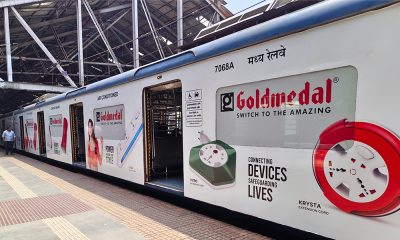

Goldmedal Electricals launches transit OOH campaign in Mumbai
The campaign showcases Goldmedal’s flagship portfolio including its Air Modular Switches, the advanced Smart Home Automation & Sensor series, LED...
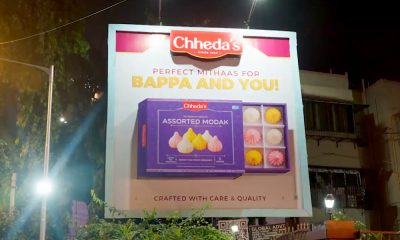

Chheda’s brings its Modak box to life with kinetic OOH for Ganesh Chaturthi
The execution features a large 3D Chheda’s Modak box built into the billboard, with the box sliding in and out...


BRND.ME’s perfume brand Villain puts its Gold Revolver on the move across Bengaluru
The activation covered key locations including Russell Market in Shivajinagar, Vidhana Soudha and Koramangala.
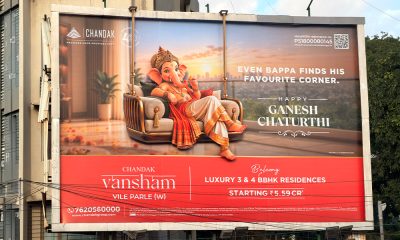

Chandak Vansham’s swinging Ganpati OOH campaign in Mumbai
The campaign is executed by Media Buying House
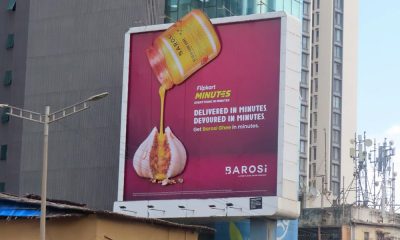

Flipkart Minutes serves up Barosi Ghee in a larger-than-life OOH execution
Flipkart Minutes brings Barosi Ghee’s food proposition to life through a 3D-inspired billboard that makes the product and its promise...
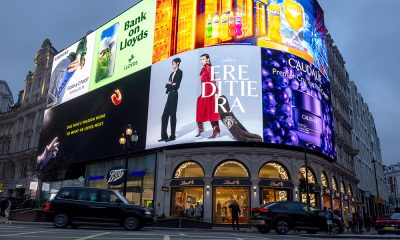

Landsec and Ocean Outdoor build on the cultural resonance of Piccadilly Lights
Changes to the screen's format come into effect from January 2027, 10 years after Piccadilly Lights relaunched following a nine-month...
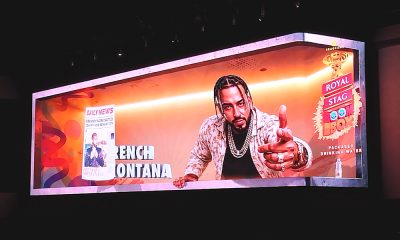

Royal Stag Boombox goes larger-than-life with anamorphic LED in Hyderabad
The campaign is conceptualised and executed by Coral Media
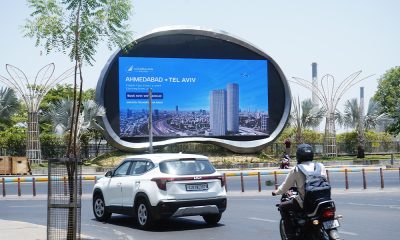

Times OOH Unveils ‘The Riviera’ in Ahmedabad
The screen is located at Sabarmati Riverfront on Ashram Road
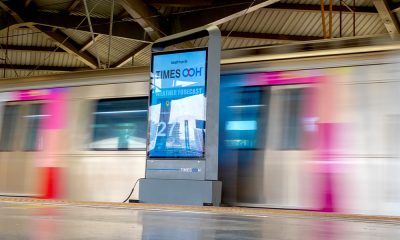

Times OOH upgrades the Media Experience on Mumbai Metro Line 1
The move to 75-inch displays gives brand creatives significantly greater visual impact, while the enhanced brightness ensures vivid, true-to-life imagery...

Broadsign released 2026 programmatic DOOH trends report
Drawing on full-year 2025 and Q1 2026 internal transaction data, the report, surfaces useful signals about what today’s buyers value...
-
 Insights
Why is India’s digital signage market not looking beyond the screen?
-
 Campaigns
Hero Destini brings ‘The Dragon’s Test’ to life through 3D anamorphic DOOH
-
Campaigns
Chandak Vansham’s swinging Ganpati OOH campaign in Mumbai
-
Campaigns
BRND.ME’s perfume brand Villain puts its Gold Revolver on the move across Bengaluru