Industry News
OOH 2025: A year marked by consolidation, new norms & collaborative campaigns
A round up of the moments and trends that shaped the OOH industry in 2025

If there was one word to describe 2025 for the Out-of-Home (OOH) industry, it would be recalibration. Across markets, the year saw consolidation at the holding-company level, sharper policy frameworks in Indian metros, stronger global collaboration, and a noticeable evolution in how brands approached outdoor creativity. Together, these moments didn’t just shape headlines, they quietly redefined how OOH is structured, regulated, and experienced. Here’s a look.
Omnicon-IPG: Consolidation meets creative reset
One of the most significant global developments this year was Omnicom’s acquisition of Interpublic Group (IPG), a move that sent ripples across advertising ecosystems worldwide, including OOH, and generated frenzied headlines.
The merger initiated a global creative restructuring, retiring long-established agency brands including DDB, FCB and MullenLowe as standalone global networks. The move reflected a broader shift in how large holding companies are rethinking scale, efficiency, and relevance in a post-network era.
From an industry-wide perspective, one that Media4Growth tracked closely, the consolidation signalled a move away from legacy agency silos toward centralised, platform-driven operating models. For OOH, this raised important questions around specialist planning, creativity, and accountability: would outdoor thinking become more integrated into omnichannel strategies, or risk being absorbed into generic media frameworks?
The merger underscored a larger reality of 2025: scale alone is no longer the differentiator, clarity of offering is.
WOO APAC Forum, Seoul: Asia steps into the global spotlight
The World Out of Home Organization (WOO) hosted its APAC Regional Forum in Seoul, South Korea, from November 5–7, 2025, which was another milestone for OOH in Asia.
Held in collaboration with the Korea Out of Home Advertising Association, the forum brought together global media owners, advertisers, agencies, and technology players at a time when Asia’s OOH markets are growing faster than many Western counterparts.
Seoul was a deliberate choice. Widely regarded as one of the most technologically advanced DOOH markets in the world, the city became a living case study for what structured regulation, premium inventory, and creative ambition can achieve together.
Discussions at WOO Seoul focused on programmatic OOH, measurement frameworks, automation, creative innovation, and regulatory alignment, reinforcing the idea that OOH’s future lies at the intersection of data, design, and discipline. The forum also highlighted how APAC markets are no longer just adopting global best practices, they are increasingly setting them.
Mumbai’s BMC OOH Policy: Regulation takes centre stage
Closer home, 2025 was a landmark year for policy intervention, particularly in Mumbai. The BMC Outdoor Advertisement Policy 2025 brought long-awaited clarity, and constraint, to the city’s outdoor landscape.
On paper, the policy focused on urban aesthetics, public safety, structural integrity, and compliance, while attempting to create space for digital expansion. Brightness norms, size restrictions, height regulations, and approval timelines were clearly outlined.
However, industry conversations throughout the year reflected lingering ambiguity, especially around DOOH permissions, brightness standards, and overlapping jurisdictions between BMC, Railways, and other authorities. While the intent was progressive, execution remained uneven, leading to concerns around innovation being stifled rather than enabled.
What the policy undeniably achieved was a reset: forcing the industry to confront the need for legitimacy, compliance, and long-term sustainability, even as it negotiates creative freedom.
Bengaluru: A quieter but significant policy shift
While Mumbai dominated headlines, Bengaluru also introduced important changes to its OOH governance framework in 2025. The focus here was less about sweeping reform and more about streamlining permissions, tightening enforcement, and addressing visual clutter.
The city’s evolving stance reflected a growing recognition that OOH is no longer peripheral to urban planning. Like Mumbai, Bengaluru’s approach sparked debate, particularly around how digital formats fit into existing civic frameworks, but it also signalled that Indian metros are beginning to treat outdoor media as a city-planning stakeholder, not just an advertising channel.
Trends that shaped OOH campaigns in 2025
Brand collaborations taking centre stage
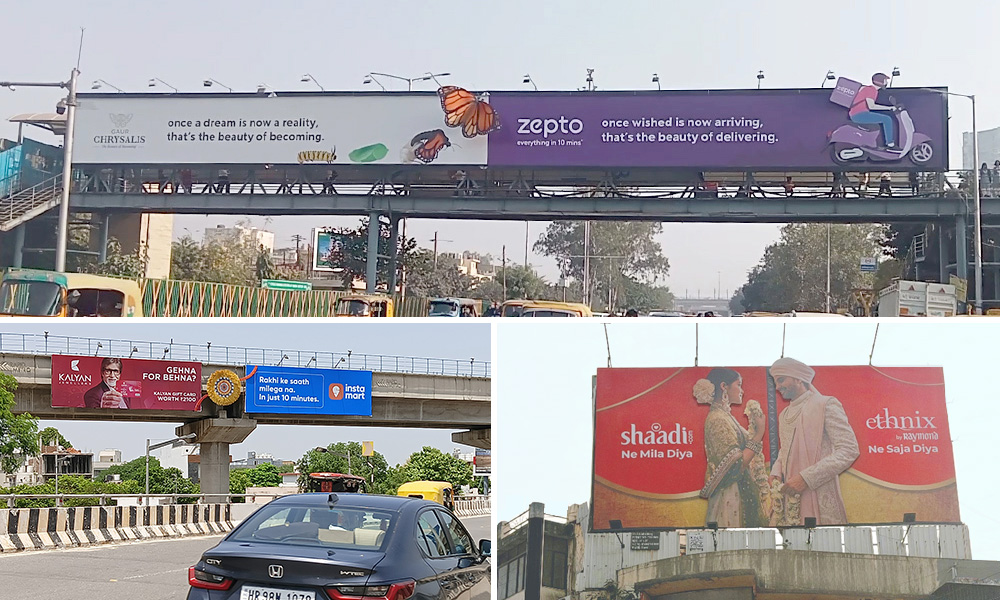
One of the most visible OOH trends in 2025 was brands choosing to collaborate with each other on outdoor sites rather than compete for attention individually. Instead of single-brand messaging, advertisers used adjacent hoardings, shared structures, or complementary creatives to create larger narratives.
Quick commerce players were at the forefront of this shift. Zepto and Swiggy, among others, executed collaborative OOH ideas where two brands played off each other’s messaging across neighbouring sites, turning highways and city junctions into conversational spaces. These executions worked because they felt organic, timely and culturally tuned, brands acknowledging each other’s presence in the same physical ecosystem rather than shouting in isolation.
This trend also reflected a broader mindset change: OOH was no longer just about owning space, but about sharing relevance. When done right, brand collaborations added wit, scale and memorability, often earning attention far beyond the physical site itself.
OOH designed for social media moments
Another defining shift in 2025 was how deliberately OOH was crafted to travel from the street to social feeds. Brands increasingly designed outdoor campaigns knowing they would be photographed, filmed and shared.
Large-scale projections emerged as powerful tools in this space. Projections on landmarks like the Worli Sea Link became visual spectacles, not just because of their scale, but because they transformed familiar city infrastructure into momentary cultural events. These executions blurred the line between outdoor advertising and public art, making the city itself feel like part of the campaign.
Canva delivered one of the year’s most talked-about OOH campaigns by turning everyday design struggles into laugh-out-loud billboards. With copy rooted in universal creative pain points, the campaign resonated instantly with designers, marketers and creators. The simplicity of the insight made it highly shareable, proving that OOH doesn’t need complexity to go viral, it needs relatability.
The campaign’s strength lay in how naturally it invited people to stop, smile, photograph and post, extending its life far beyond the billboard.
In 2025, OOH wasn’t just amplified by social media; it was built for it.
Humour-led OOH making brands human
Humour emerged as one of the strongest creative tools in outdoor advertising this year. In an environment overloaded with serious brand messaging, campaigns that made people laugh stood out instantly.
Tinder’s now-famous garbage truck activation became a defining example. Turning a municipal vehicle into a tongue-in-cheek metaphor for “emotional baggage”, the brand used humour to spark real-world interaction while remaining culturally sensitive and self-aware. The activation felt less like advertising and more like a shared joke between brand and audience, a quality that made it both memorable and widely discussed.
Across markets, humour-driven OOH leaned into sharp copy, situational wit and cultural references, reminding the industry that outdoor advertising doesn’t always need grandeur, sometimes, a clever line in the right place is enough to stop traffic.
The bigger picture
What tied these trends together in 2025 was a common creative instinct: make OOH feel alive. Whether through collaborations, social-first thinking, or humour, brands used outdoor media to enter everyday conversations, not interrupt them.
OOH this year wasn’t about shouting louder.
It was about being smarter, funnier, more shareable, and unmistakably present in real life.


Daily Newsletter
Subscribe to receive the latest OOH
industry updates

Traya Health uses a 7-ft hair-filled cube to start a conversation on hair fall

Aashirvaad Salt Active takes heart-health message to Delhi streets

adfest unveils new logo designed by Santosh Padhi of Into Creative

Sunder Balasubramanian concludes four-year tenure as Myntra CMO

“Media in Gujarat is becoming very expensive”

Puma becomes PVMA for PV Sindhu

HOCCO’s Aamchi campaign brings mango tree to Ahmedabad

Blinkit in association with Kinetic India goes all Bollywood

Acclaimed Actor Manoj Joshi to deliver an inspirational address at OAC 2024

Zepto’s Fast 10 Minute Delivery Saves the Day for Game Night in Ahmedabad!

‘Let’s create an empathetic space for women’

‘It won’t just be a man’s world anymore’

‘We’re actively exploring acquisitions and working to increase our inventory’

A habit of success at Prakash Arts

‘OOH is an important channel to connect with corporate audiences’

Video Editor
Job Description: Editing videos of editorial interviews, in-house events, video podcasts, promotional videos and others based on team brief Planning...
Content Editor-Writer
Job Description: Editing daily news copies and magazine articles Writing industry research and interview based articles and client focused content...

Sales Manager (Amritsar, J&K, Chandigarh, Mumbai, Vadodara, Udaipur, U.P.)
Orango has been involved in creating, building, reviving and growing brands. Orango builds powerful connections with their customers & people...

Sales Executive
Established B2B Media and Events Group VJ Media Works is looking for sales executives
Digital Marketing/Social Media Executives
Established B2B Media and Events Group VJ Media Works is looking for the following: Digital Marketing/Social Media Executives Location: Mumbai/Bangalore...

Sales Manager – AdZ (Digital Advertising)
Estontec Group’s fast-growing adtech brand AdZ is hiring a Sales Manager to drive digital media sales and client growth. This...
Onboarding Specialist
Join Estontec Group’s transit media brand BrandonWheelz as an Onboarding Specialist, managing campaign execution, vendor coordination, and media planning across...


Operation Manager
Company Description: BajuGali an Advertisement Company is a leading firm specializing in advertising and marketing services. We provide innovative solutions...

BackLite UK upgrades Landscape Gallery portfolio
The Landscape Gallery is a portfolio of eight high-quality, high-resolution LED technology large-format digital screens positioned in prime London gateways...

Ambrane brings a playful twist to metro OOH for its charging cables
Ambrane has taken its charging cable campaign inside the metro, using witty, relatable copy to turn everyday commuter moments into...


Flipkart brings Big Billion Days to life at Bengaluru’s Metro
As Big Billion Days 2026 approaches, Flipkart is taking its festive sale into the daily commute with a metro-led OOH...

Digger takes a big swing at LA with larger-than-life 3D OOH
Tom Cruise’s upcoming film Digger turns a conventional billboard into a physical extension of its campaign, with a giant shovel...

Mangalam brings #BreatheBhimseni experience at Lalbaugcha Raja
The installation transforms a part of the Lalbaugcha Raja queue into an immersive passage inspired by the purity and freshness...

Dubai Mall expands its DOOH network with 1,100 sqm of LED displays
Emaar Properties has reportedly deployed approximately 1,100 sq m of LED displays across indoor and outdoor areas of Dubai Mall,...


Broadsign bags contract with Context Networks for screen network in 14 US states
Through the collaboration, Context Networks is connecting eligible CPMN™ inventory to the Broadsign Platform, the company’s complete, reliable Ad Server...

Landsec and Ocean Outdoor build on the cultural resonance of Piccadilly Lights
Changes to the screen's format come into effect from January 2027, 10 years after Piccadilly Lights relaunched following a nine-month...

Royal Stag Boombox goes larger-than-life with anamorphic LED in Hyderabad
The campaign is conceptualised and executed by Coral Media

Times OOH Unveils ‘The Riviera’ in Ahmedabad
The screen is located at Sabarmati Riverfront on Ashram Road