
Insights
Why OOH must evolve to build urban spaces
In this piece, first published in the August edition of Outdoor Asia, C D V Subbarao, CEO & Director of Prakash Arts, shares his views on how OOH can contribute to better urban spaces.

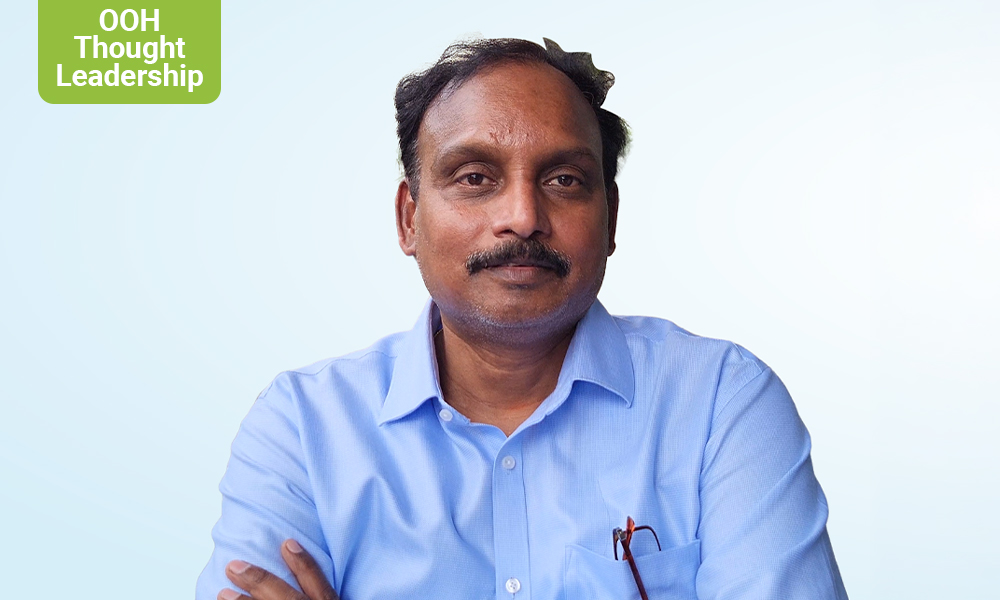
For C D V Subbarao, out-of-home (OOH) advertising has always been capable of being much more than a medium for brand visibility. Over the years, Prakash Arts has been involved in multiple PPP and city beautification projects, including large-scale footpath redevelopment initiatives, which he believes have created value far beyond commercial returns.
“Only putting up a billboard benefits the business and the customer. But when we build public infrastructure, we are contributing to society. That gives much greater satisfaction,” he says, reflecting a larger vision.
Addressing the perception challenge
Subbarao believes public infrastructure and development initiatives will also help fundamentally alter how the industry is perceived by governments and citizens.
This is important because, as he says, OOH companies have historically been viewed as entities that simply monetise public spaces, despite its contribution to city economies and urban communication. This is one of the reasons he feels OOH advertising still does not receive the institutional respect it deserves.
“Even today, OOH is not a priority for many corporations because there is the perception that there is a lot of money in this industry, but that media owners are contributing very little,” he points out and highlights how the business realities are often very different. Rising licence costs, increasing competition and operational expenses have significantly impacted profitability across the sector.
The disconnect between reality and perception, he believes, has prevented the industry from receiving the policy support and long-term thinking that it requires. For him, changing this perception is critical for the industry’s future growth. By participating in urban development projects, media owners can demonstrate that they are equally invested in improving cities and public infrastructure.
Citing an example of Prakash Arts’ recent project, he says, “We developed more than three kilometres of footpaths with proper granite work and public amenities. Projects like these create goodwill because people start seeing that the industry is giving something back.”
Why long-term policies matter
Subbarao also strongly believes that the industry’s infrastructure challenges are directly linked to short-term policy frameworks. “If permissions are given only for two or three years, why would anyone invest heavily in engineering and infrastructure?” he asks, quite justifiably. He believes that longer tenures would completely change the quality of outdoor assets across the country. Greater certainty would encourage investments in structural design, soil testing, engineering studies and safety mechanisms.
“When you know that you have an asset for ten or fifteen years, you are willing to spend much more money on making that structure stronger and safer,” he points out, and cites airport media assets as examples of how long-term tenures lead to better infrastructure and higher-quality installations. “You see stable structures in airports because operators have long-term visibility. The same thinking should be applied to city media as well.”
Indian OOH needs one policy framework
Fragmented regulatory environment is another critical challenge, according to Subbarao. “Not just every state, every city has its own policy.” This, he feels, creates unnecessary complexity for media owners, especially those looking to expand across markets. Different approval mechanisms, varying by-laws and changing regulations often increase operational uncertainty and discourage investments. “There should be an all-India policy for at least ten years. This will draw more investments,” he says.
How the real estate sector has changed OOH economics
Subbarao also points to the real estate sector as one of the biggest contributors to OOH’s recent growth. “Earlier, campaigns would last for fifteen days or one month. Real estate changed that.” Long-duration campaigns from real estate brands have introduced greater stability into the business and improved revenue visibility for media owners, he feels. “Because of real estate, sustainability has come into the business.”
While Subbarao remains cautious about predicting explosive growth, he believes advertising spends will continue to rise steadily over the coming years.
Need for balanced DOOH growth
Regarding digital OOH (DOOH), although he acknowledges its rapid growth, Subbarao remains pragmatic about its future. “Today, digital is still only around four or five per cent of the industry,” he points out.
According to him, digital works best in situations where multiple advertisers are competing for premium locations. “When the same location may be required by four or five advertisers, then digital can create more value.” However, he questions the tendency to indiscriminately digitise every available location. “If there are already ten permissions in an area, why should everything become digital?” He believes the industry must ensure that digital growth remains commercially sustainable and is supported by genuine market demand, rather than simply following global trends.
Why the industry needs institutional participation
For most OOH industry players, having an all-India presence is an obvious goal and an understandable aspiration, but Subbarao also feels that the next phase of growth will require larger institutional participation and long-term investments. “More multinational companies should come into Indian outdoor advertising.” According to him, stronger institutions, better governance frameworks and larger investments will ultimately determine how quickly the industry can evolve.
The future of outdoor advertising, according to Subbarao, is not merely about increasing inventory or introducing more digital screens, it’s about people and public infrastructure.
Ultimately, he believes the industry has an opportunity to reposition itself, not merely as an advertising medium, but as a contributor to urban development and city building. Only then, he emphasises, will outdoor advertising truly earn the trust, respect and long-term support it deserves.







Daily Newsletter
Subscribe to receive the latest OOH
industry updates

Orango Solutions secures exclusive advertising rights at Dehradun Airport for seven years

Honitus turns coughs into music across cities, links relief to Blinkit

Rajouri Garden metro station now goes by Ai+ NOVA

Zepto brings Bappa’s favourite messenger to the seafront

Beyond selling a product to building an ecosystem

Puma becomes PVMA for PV Sindhu

HOCCO’s Aamchi campaign brings mango tree to Ahmedabad

Blinkit in association with Kinetic India goes all Bollywood

Acclaimed Actor Manoj Joshi to deliver an inspirational address at OAC 2024

Zepto’s Fast 10 Minute Delivery Saves the Day for Game Night in Ahmedabad!

‘Let’s create an empathetic space for women’

‘It won’t just be a man’s world anymore’

‘We’re actively exploring acquisitions and working to increase our inventory’

A habit of success at Prakash Arts

‘OOH is an important channel to connect with corporate audiences’


Sales Manager (Amritsar, J&K, Chandigarh, Mumbai, Vadodara, Udaipur, U.P.)
Orango has been involved in creating, building, reviving and growing brands. Orango builds powerful connections with their customers & people...

Sales Executive
Established B2B Media and Events Group VJ Media Works is looking for sales executives
Digital Marketing/Social Media Executives
Established B2B Media and Events Group VJ Media Works is looking for the following: Digital Marketing/Social Media Executives Location: Mumbai/Bangalore...

Sales Manager – AdZ (Digital Advertising)
Estontec Group’s fast-growing adtech brand AdZ is hiring a Sales Manager to drive digital media sales and client growth. This...
Onboarding Specialist
Join Estontec Group’s transit media brand BrandonWheelz as an Onboarding Specialist, managing campaign execution, vendor coordination, and media planning across...


Operation Manager
Company Description: BajuGali an Advertisement Company is a leading firm specializing in advertising and marketing services. We provide innovative solutions...


Senior Copy Editor
No of openings: 1 Experience/ qualifications: 3-4 years in any media/news publication Graduate Degree in any discipline, degree in Journalism...


Sales Specialist at BajuGali (OOH Advertising Company)
At BajuGali, we are a marketing and advertising agency that specializes in transforming creative visions into reality for brands and...


Hamdard reimagines skincare for Gen Z through new-age OOH
The campaign is executed by WPP Media


Qubo puts its security cameras on billboards, literally
The campaign is executed by Platinum Outdoor with Sakshi Advertising as production partner


Claire’s pierces a billboard in New York
In New York City, a massive billboard was turned into a canvas for oversized 3D earrings.

Trip.com turns Dhoby Ghaut MRT into a personal travel story
For the second year running, Trip.com has transformed Singapore’s Dhoby Ghaut MRT station into an immersive travel experience, inviting commuters...

Fortune Soya Health brings ‘Baarish Ke Saath Pakodon Ka Swaad’ to the streets
The OOH innovations are conceptualised and executed across Delhi, Lucknow and Patna by Coral Media


Landsec and Ocean Outdoor build on the cultural resonance of Piccadilly Lights
Changes to the screen's format come into effect from January 2027, 10 years after Piccadilly Lights relaunched following a nine-month...

Royal Stag Boombox goes larger-than-life with anamorphic LED in Hyderabad
The campaign is conceptualised and executed by Coral Media

Times OOH Unveils ‘The Riviera’ in Ahmedabad
The screen is located at Sabarmati Riverfront on Ashram Road

Times OOH upgrades the Media Experience on Mumbai Metro Line 1
The move to 75-inch displays gives brand creatives significantly greater visual impact, while the enhanced brightness ensures vivid, true-to-life imagery...

Broadsign released 2026 programmatic DOOH trends report
Drawing on full-year 2025 and Q1 2026 internal transaction data, the report, surfaces useful signals about what today’s buyers value...


