
Insights
“AI companies should build barriers against copyright violation”
Next up in Media4Growth’s ‘AI & Creative Ownership’ series, Vinit Patil, Creative Director at Sociowash, speaks about the viral AI-generated Amul creative controversy, copyright ambiguity, AI-generated ideas, and why brands need to publicly clarify their stance in the age of generative content.

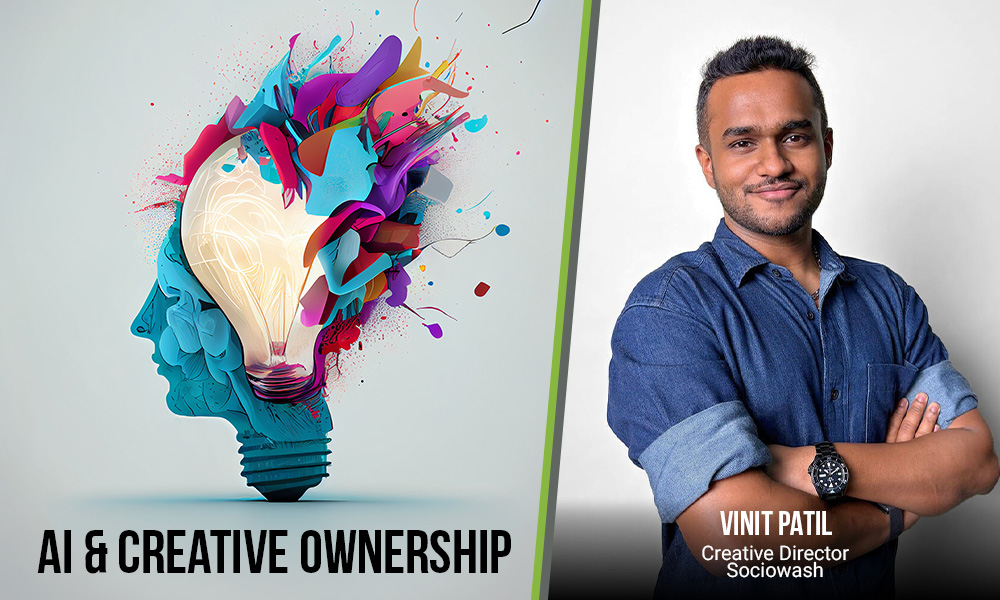
When AI can replicate a brand’s identity, visual language, and tonality within minutes, where does originality end and imitation begin? This is a question that has gained much significance.
Recently an AI generated creative on social media was assumed to be an official Amul topical, until the brand publicly clarified that the creative was not associated with them in any way. The incident quickly became a larger conversation around AI-generated advertising, misinformation, copyright, and brand accountability.
For Vinit Patil, Creative Director at Sociowash, the issue reflects both the accessibility and the unpredictability of AI today.
“AI is accessible to everybody, it’s not just restricted to brands or agencies,” he says.
According to Vinit, while AI has become a powerful creative tool, the industry still lacks awareness around the responsible use of brand identities and copyrighted communication.
“I think copyright laws are not taken very seriously,” he says. “But that’s just one part. The other fact is that people are just not aware that they can’t just randomly use some brand’s ideology or identity and make something out of it.” Indeed, as Vinit points out that there is no conscious thinking regarding the ethics of simply borrowing a brand’s identity and creating something out of it.
At the same time, he points out that speculative advertising itself is not new to the industry. “Spec ads have always existed in advertising as a very fun medium,” he says. “But if done responsibly, it works well.”
However, AI changes the scale and realism of those creations dramatically, making it harder for audiences to distinguish between official campaigns and AI-generated replicas.
For Vinit, this makes public clarification essential for brands whenever such incidents occur. “It’s very important to come out and say something because not saying is also agreeing with it or letting it slide,” he says.
He believes silence only fuels public assumption. “It becomes imperative that you come forward and give your two cents on it. Make your position clear or your stance clear. This is how we stand with it. This is not something that we condone.”
Because once assumptions begin circulating online, controlling perception becomes significantly harder. “Unless you clear it, people are going to assume things,” he says. “And letting people assume something is a very dangerous place to be in.”
Despite the growing concerns around AI-generated communication, Vinit is clear that he does not see AI itself as the enemy of creativity. “For me, AI is always something that helps you do things, not does things for you,” he says.
According to him, AI works best when it assists execution after a human insight or idea already exists. “If you have an idea or an insight that you think of, sure, you can put that into AI and get it to do a screenplay and different versions of it. That works.”
But relying on AI to originate ideas, defeats the very purpose of creativity, he feels. “Using it to generate ideas defeats the purpose,” he says. “Technologically also, AI basically delves into the past, draws data from the past, and gives you something.”
He concedes that AI-generated “ideas” are fundamentally derived from existing patterns rather than true originality. “So if you are asking AI for an idea, it’s not a real idea anyway,” he says. “It’s an inspiration or a copy by default. It’s literally how AI works.”
Vinit also believes responsibility cannot rest only with brands and agencies. AI platforms themselves, according to him, will eventually need to introduce stronger safeguards around copyrighted content and brand replication.
He adds, “There are some AI agents that take copyright laws into account. If you ask them to generate a Hermès bag with XYZ things on it, it will refuse to generate it because it holds a copyright law.”
However, he acknowledges that implementing copyright enforcement inside AI systems is far more complicated than it appears. “The copyright definition is vague,” he says. “Sometimes a slight deviation from the law makes it original.”
He compares this ambiguity to music copyright structures. “With a song, if you change three tones in a song, it becomes a completely new song with no copyright, even if everything else is the same.”
Even so, he believes AI companies should still attempt to build barriers wherever possible.
“AI agents should implement it to whatever capacity they can,” he says. “That will at least reduce the masses from falling into the trap.” At the same time, he admits that no system will ever completely eliminate misuse.
“If someone has to get past it, they will get past it anyway,” he says. “But at least it will become a gateway to not do it. Like a first-level barrier.”
For Vinit, the Amul controversy is ultimately not just about one viral AI-generated creative. It represents a much larger transition the industry is now entering, one where technology is making imitation easier than ever, while brands, agencies, and platforms are still trying to define what originality, ownership, and accountability actually look like in the age of AI.

Daily Newsletter
Subscribe to receive the latest OOH
industry updates

Can regulation catch up with advertiser demand in Gujarat?

Ambrane brings a playful twist to metro OOH for its charging cables

MADC invites bids for advertising rights at Amravati Airport

AAI Floats advertising rights tender for Bhavnagar Airport

OOH in Gujarat: Growing demand, growing need for certainty

Puma becomes PVMA for PV Sindhu

HOCCO’s Aamchi campaign brings mango tree to Ahmedabad

Blinkit in association with Kinetic India goes all Bollywood

Acclaimed Actor Manoj Joshi to deliver an inspirational address at OAC 2024

Zepto’s Fast 10 Minute Delivery Saves the Day for Game Night in Ahmedabad!

‘Let’s create an empathetic space for women’

‘It won’t just be a man’s world anymore’

‘We’re actively exploring acquisitions and working to increase our inventory’

A habit of success at Prakash Arts

‘OOH is an important channel to connect with corporate audiences’

Video Editor
Job Description: Editing videos of editorial interviews, in-house events, video podcasts, promotional videos and others based on team brief Planning...
Content Editor-Writer
Job Description: Editing daily news copies and magazine articles Writing industry research and interview based articles and client focused content...


Sales Manager (Amritsar, J&K, Chandigarh, Mumbai, Vadodara, Udaipur, U.P.)
Orango has been involved in creating, building, reviving and growing brands. Orango builds powerful connections with their customers & people...

Sales Executive
Established B2B Media and Events Group VJ Media Works is looking for sales executives
Digital Marketing/Social Media Executives
Established B2B Media and Events Group VJ Media Works is looking for the following: Digital Marketing/Social Media Executives Location: Mumbai/Bangalore...

Sales Manager – AdZ (Digital Advertising)
Estontec Group’s fast-growing adtech brand AdZ is hiring a Sales Manager to drive digital media sales and client growth. This...
Onboarding Specialist
Join Estontec Group’s transit media brand BrandonWheelz as an Onboarding Specialist, managing campaign execution, vendor coordination, and media planning across...


Operation Manager
Company Description: BajuGali an Advertisement Company is a leading firm specializing in advertising and marketing services. We provide innovative solutions...


Flipkart brings Big Billion Days to life at Bengaluru’s Metro
As Big Billion Days 2026 approaches, Flipkart is taking its festive sale into the daily commute with a metro-led OOH...


Digger takes a big swing at LA with larger-than-life 3D OOH
Tom Cruise’s upcoming film Digger turns a conventional billboard into a physical extension of its campaign, with a giant shovel...


Mangalam brings #BreatheBhimseni experience at Lalbaugcha Raja
The installation transforms a part of the Lalbaugcha Raja queue into an immersive passage inspired by the purity and freshness...


iPhone 18 Pro takes over a billboard in Surat
The iPhone 18 Pro has just launched, and Surat's already talking about it.


Hero Destini brings ‘The Dragon’s Test’ to life through 3D anamorphic DOOH
For the campaign, Hero MotoCorp partnered with DGTOOHL as its Programmatic Digital Out-of-Home (PDOOH) partner, with the activation powered by...


Broadsign bags contract with Context Networks for screen network in 14 US states
Through the collaboration, Context Networks is connecting eligible CPMN™ inventory to the Broadsign Platform, the company’s complete, reliable Ad Server...


Landsec and Ocean Outdoor build on the cultural resonance of Piccadilly Lights
Changes to the screen's format come into effect from January 2027, 10 years after Piccadilly Lights relaunched following a nine-month...

Royal Stag Boombox goes larger-than-life with anamorphic LED in Hyderabad
The campaign is conceptualised and executed by Coral Media


Times OOH Unveils ‘The Riviera’ in Ahmedabad
The screen is located at Sabarmati Riverfront on Ashram Road


Times OOH upgrades the Media Experience on Mumbai Metro Line 1
The move to 75-inch displays gives brand creatives significantly greater visual impact, while the enhanced brightness ensures vivid, true-to-life imagery...