
Talks OOH
OOH has the reach but brands want the numbers
Brands at Gujarat Talks OOH 2026 said Gujarat’s OOH potential is real and growing, but they need clear data and benchmarks to decide how much to spend.

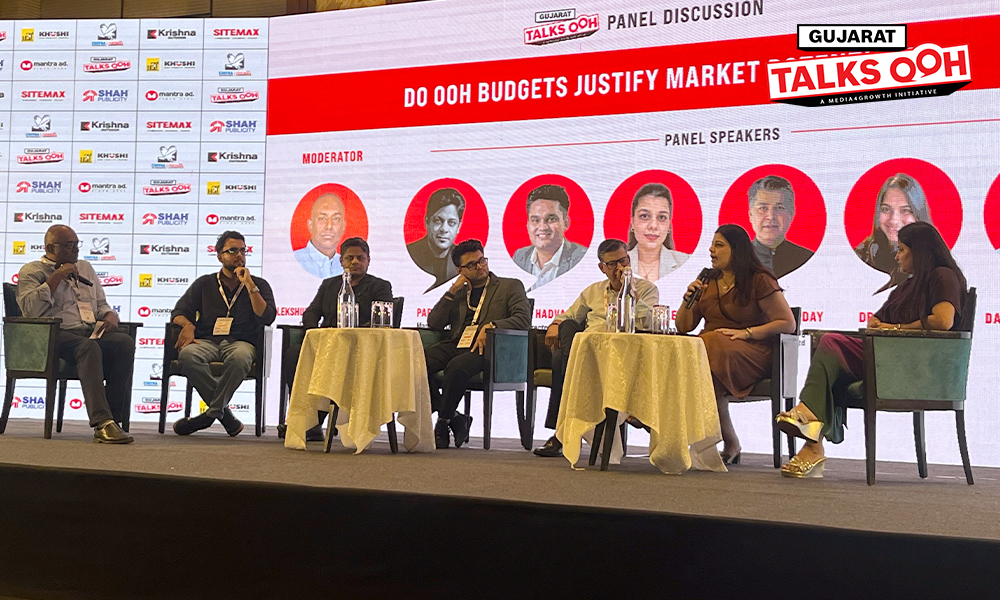
At Gujarat Talks OOH 2026, held at Hyatt, Ahmedabad, a power-packed panel of marketers from FMCG, retail, real estate and technology came together to discuss “Do OOH budgets justify the market’s potential?”
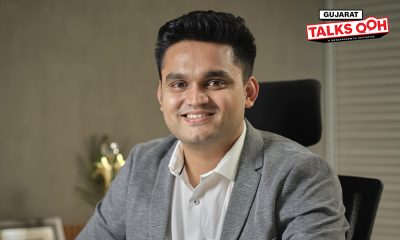
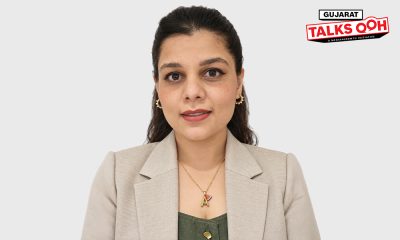
Moderated by Lekshumanan Annamalai, Co-Founder and CEO of Coral Media, the panel brought together Parth Patel, MD of Kavisha Group; Raj Hadvani, Director and CEO of Gopal Namkeen; Afiya Malek, Senior Brand Manager of Hocco; Rohit Markanday, Associate General Manager of AWL Agri Business Ltd; Druma Mehta, VP – Marketing of JadeBlue Lifestyle; and Darshit Sanghani, Marketing Officer of Odoo India.
Opening the discussion, Lekshumanan asked the panelists whether OOH spends justify the market’s potential.
Going first, Rohit Markanday of AWL Agri Business Ltd drew a comparison with health measures such as BMI and daily calorie intake, asking agencies and media owners to establish the right number of OOH units for a city like Ahmedabad and the ideal campaign duration for objectives ranging from packaging changes to consumer promotions.
He also urged agencies to think beyond hoardings and bus shelters, noting that AWL has branded a train locomotive. “Engine is the moving hoarding,” he said. “It travels across India.” He added that the company’s spends on OOH have grown four to five times in five years, and that it now invests heavily in melas and festivals such as Puri Rath Yatra and Durga Puja.
Gujarat’s growth story
Darshit Sanghani of Odoo India said the state’s momentum strengthens the case for outdoor. “Everything in Gujarat is growing in every aspect,” he said, pointing to infrastructure, entertainment and large events, including the upcoming Commonwealth Games in Ahmedabad.
On measurement, he explained that Odoo uses outdoor purely for brand building and tracks branded search volume before and after a campaign. “If search volume has increased 40 to 60 percent, we can attribute at least 25 to 30 percent to the outdoor campaign,” he said.
Sniper versus carpet bombing
Druma Mehta of JadeBlue Lifestyle said every campaign needs its own strategy and described how the brand balances OOH and digital. “TV is like an air force, carpet bombing. But if you want to go regionally, OOH is the best medium,” she said. “Digital is like a sniper.”
In Gujarat, where the brand is already strong, JadeBlue leans digital. In the 11 cities outside the state, it first builds awareness through large hoardings and then retargets digitally. She also flagged the gap: “I can attribute digital. That part is missing in outdoor, which I would request agencies and media owners to help brands with.”
Speaking about apparel, she also said digital OOH is becoming important because it can show multiple garments, unlike a standalone unipole or hoarding that carries one. “For an apparel brand, digital OOH will have more recall because we are showing different clothes,” she said. JadeBlue uses print in the metros as it aims to become a national brand, and uses BTL mainly for large store launches.
Innovation and engagement
Afiya Malek of Hocco said OOH has held its ground against digital migration. “It is one of the only traditional media that has doubled in spite of the digital migration,” she said. For Hocco, she added, the aim is to make consumers stop, as with its bullet-shaped ice cream hoarding created with Mirzapur. “The engagement has to go beyond visibility for it to make an impact for us,” she said.
On the media mix, she said ATL and BTL must work together. “BTL is the first interaction, the Zero Moment of Truth (ZMOT) for my customer, and ATL is extremely important for brand building. They cannot work in isolation,” she said, adding that India is diverse and every state and city behaves differently.
No single medium
Raj Hadvani of Gopal Namkeen said their brand splits its spend roughly equally between ATL and BTL, with the mix shifting by product and geography. “I cannot rely on any single medium for communication, because my customer may be stuck in traffic, sitting in a car,” he said.
Real estate: from hoardings to experiences
Parth Patel said hoardings have replaced newspapers as the main medium for developers. “Whenever we want to launch something, the first thing that comes to mind is whether hoardings are available. We can even delay a campaign because a hoarding is not available,” he said. For real estate, he added, OOH is a brand-building exercise rather than a direct sales driver, so cost matters less than the right location.
He described how his company went from 40 hoardings on day one to just four sites on main crossroads, which have built a premium brand image in two years. “You don’t get to know in digital media, because there is FMCG, fashion, travel. You get lost,” he said. He added that hoardings serve different audiences. “For employees, there is a pride in seeing the brand on a hoarding. For retailers and distributors, it is reassuring.”
The discussion closed with panelists agreeing on the fact that OOH delivers visibility, recall and pride, but that agencies and media owners must now back it with research and measurable benchmarks for the brands to increase their budget allocation in OOH medium.



Daily Newsletter
Subscribe to receive the latest OOH
industry updates

“There is no better media for regional brands than outdoor”

Third edition of Gujarat Talks OOH kicks off in Ahmedabad

Kavisha Group’s MD Parth Patel to join Gujarat Talks OOH panel on budgets and market potential

Raj Hadvani, Director-CEO of Gopal Namkeen, joins Gujarat Talks OOH panel

Darshit Sanghani of Odoo India to join Gujarat Talks OOH panel on OOH budgets and market potential

Puma becomes PVMA for PV Sindhu

HOCCO’s Aamchi campaign brings mango tree to Ahmedabad

District uses Samay Raina’s signature shirt to announce his live show

Blinkit in association with Kinetic India goes all Bollywood

Acclaimed Actor Manoj Joshi to deliver an inspirational address at OAC 2024

‘Let’s create an empathetic space for women’

‘It won’t just be a man’s world anymore’

‘We’re actively exploring acquisitions and working to increase our inventory’

A habit of success at Prakash Arts

‘OOH is an important channel to connect with corporate audiences’

Video Editor
Job Description: Editing videos of editorial interviews, in-house events, video podcasts, promotional videos and others based on team brief Planning...
Content Editor-Writer
Job Description: Editing daily news copies and magazine articles Writing industry research and interview based articles and client focused content...


Sales Manager (Amritsar, J&K, Chandigarh, Mumbai, Vadodara, Udaipur, U.P.)
Orango has been involved in creating, building, reviving and growing brands. Orango builds powerful connections with their customers & people...

Sales Executive
Established B2B Media and Events Group VJ Media Works is looking for sales executives
Digital Marketing/Social Media Executives
Established B2B Media and Events Group VJ Media Works is looking for the following: Digital Marketing/Social Media Executives Location: Mumbai/Bangalore...

Sales Manager – AdZ (Digital Advertising)
Estontec Group’s fast-growing adtech brand AdZ is hiring a Sales Manager to drive digital media sales and client growth. This...
Onboarding Specialist
Join Estontec Group’s transit media brand BrandonWheelz as an Onboarding Specialist, managing campaign execution, vendor coordination, and media planning across...

Operation Manager
Company Description: BajuGali an Advertisement Company is a leading firm specializing in advertising and marketing services. We provide innovative solutions...

Jio celebrates its stock market debut with a spectacular drone show at Wankhede Stadium
The large-scale aerial display marked Jio Platforms’ market listing, turning a major corporate milestone into a public spectacle across Mumbai’s...
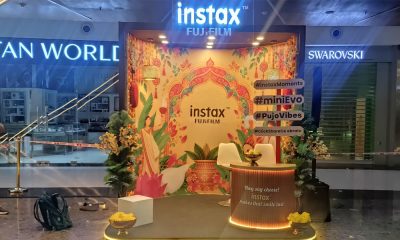

Fujifilm Instax takes its instant photography experience to Delhi and Kolkata
It was initiated and facilitated by Times One, a Times Group Company.
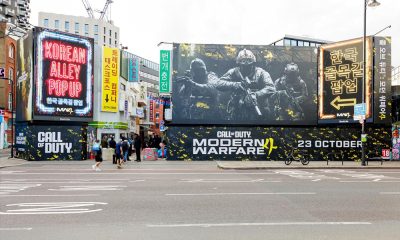

Call of Duty brings Korean Alleyway to life in London and Los Angeles
The experience was developed by Activision in partnership with Omnicom Media and Amazon Ads.
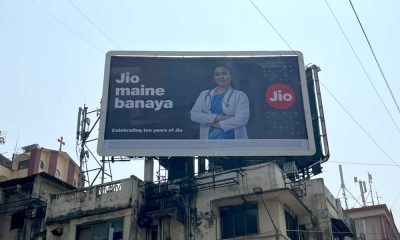

Jio marks 10 years with ‘Jio maine banaya’ outdoor campaign
Featuring everyday Indians across large-format hoardings and digital billboards, the campaign puts people at the centre of Jio’s decade-long journey.
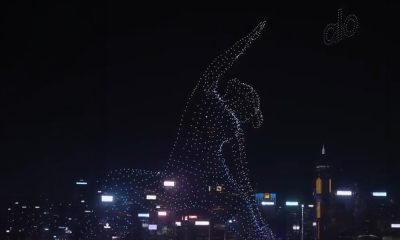

ALO brings its brand spectacle to Hong Kong with a larger-than-life outdoor execution
As drone shows compete for attention in the skies, ALO is finding another way to make an impression, using large-scale...

Alberta Cancer Foundation turns movie spoilers into a life-saving OOH campaign
The ‘Life-Saving Spoilers’ campaign uses iconic film and television plot twists to encourage people to get mammograms, turning a familiar...

WOW Advertisement adds eight digital OOH screens across Ahmedabad and Surat
The expansion includes seven traffic LED screens across Ahmedabad and a 41 ft × 60 ft curved outdoor LED screen...

billups celebrates its anniversary by putting its people on billboard
The campaign is participating in fifteen locations across Asia, Europe and North America, including Belgrade, Amsterdam, Brussels, Berlin, Chicago. Portland,...

PDSN Media expands corporate DOOH network with new screens at Fulcrum
The new inventory comprises two 8×8 ft digital LED screens installed across Wing A and Wing B of the Mumbai...

Dubai Mall expands its DOOH network with 1,100 sqm of LED displays
Emaar Properties has reportedly deployed approximately 1,100 sq m of LED displays across indoor and outdoor areas of Dubai Mall,...
-
Campaigns
Jio marks 10 years with ‘Jio maine banaya’ outdoor campaign
-
 Talks OOH
Deepa Gupta, SVP at MOMS Outdoor, to moderate panel at Gujarat Talks OOH
-
Campaigns
ALO brings its brand spectacle to Hong Kong with a larger-than-life outdoor execution
-
Campaigns
Jio celebrates its stock market debut with a spectacular drone show at Wankhede Stadium