
Company News
How this bunch of students from NIT Rourkela is building an OOH marketplace
A team of second-year engineering students at NIT Rourkela has built HoardSpace, a marketplace for buying and selling outdoor advertising space, signing up 25+ vendors and 3,000+ billboards across 15 states in three months.

Debi Prasad Sahoo was two years into a Chemical Engineering degree at NIT Rourkela when he started noticing billboards across Odisha sitting empty for months at a stretch. “The outdoor advertising industry is highly unorganised, managed by thousands of individuals,” Debi says. “There are many billboards that haven’t been booked for months, sometimes four to five months, and that’s a huge revenue loss for the vendor and the agency. At the same time, the client can’t get that billboard at a cheaper price.”
That observation became HoardSpace. “We wanted to make the whole outdoor advertising industry digital, to build a marketplace just like Amazon, where a vendor can onboard their entire inventory in real time,” Debi says. On the client side, the idea works the same way: a client searches for a location, HoardSpace shows what’s available, and the client can send a booking request that the team confirms within a few hours.
The team
The core team is made up of second-year students from six different engineering departments at NIT Rourkela. Debi, from Chemical Engineering, is the founder. Arka Pal, from Computer Science, built the platform’s front end and design. Ayantik Sarkar, from Civil Engineering, leads the backend and AI integration, working alongside Shuvam Satapathi, from Artificial Intelligence, who co-runs the backend. Churepally Neha, also from Civil Engineering, handles vendor management and graphic design. Gagan Sharma, from Chemical Engineering, runs digital marketing and social media, and Preetam Samal, from Food Process Engineering, works on marketing.
How the platform works
On HoardSpace, clients can search for hoardings by name or address, and filter by state, city, hoarding type, lit or non-lit, size, and price. There’s a map view showing every listing across India, and vendors can add their own hoardings directly through the platform. Every listing includes campaign availability dates, pricing, and property details, along with a downloadable specification sheet. “These descriptions are generated using our AI,” Arka says, “and the data is pulled from the Google Maps API, which calculates the traffic and footfall of the area.” A comparison tool also lets a client select two or three hoardings and view them side by side across city, location, category, price, size, and availability.
The platform’s central bet is HoardSpace AI, which lets a user type in a request and get back a filtered list of hoardings. “This is going to be one of our core features in the future,” Ayantik says. “Right now we’re doing it for free using free services, but when we have enough credits to integrate AI properly into the core platform, buyers and vendors will be able to manage the entire platform using our AI.” Today, the tool can filter hoardings by budget, city, and industry (categories such as real estate or education for instance), and answer general questions about how outdoor advertising works.
Where the “Reach” numbers come from
Each listing shows an estimated reach figure, generated by feeding location coordinates into their AI through the Google Maps API. Vendors can revise a listed reach if they feel it should be higher or lower, though Ayantik notes the change is verified on their end before it goes live: “They can do that, but we will verify it from our side whether it is actually right or wrong.”
Debi was direct about the limits of the footfall estimate: “There can’t be any technology that can indicate if a person is looking at the hoarding or not. We can only predict the footfall to the location, how many people, how many vehicles have visited that location. That is near-accurate, as we are using the Google Maps API, and to be precise, we are using Gemini’s API, which gives us the data from Google Maps.”
Revenue Model
Listing on HoardSpace is currently free for vendors, as is the software they use. “We are basically a marketplace, without vendors we can’t get clients, and without clients we can’t get vendors,” Debi says. “So we onboard both of them, and eventually we will charge from both of them. Right now we don’t charge vendors, the listing is free, the software is free, but in the future, we may charge from them.” On the client side, the plan is to earn a commission on bookings.
Traction so far
The team started onboarding vendors about three months before this conversation, working from Odisha first. “We have 25-plus vendors, and around 60 to 70% of our vendors are from Odisha,” Debi says. “Right now we have 3,000-plus billboards in around 200-plus locations on our platform, covering 15-plus states.”
Two client campaigns have been completed so far. In just one month of marketing for these two clients, HoardSpace generated a revenue of ₹3.91 lakhs, and the team is targeting ₹2 crore over the next two years.
The commission model is built around actual outcomes: HoardSpace only charges a client once a billboard is successfully booked through the platform, taking a 5–6% commission on the total rent of the billboards booked.
The team is currently in talks with incubation centres at IIT Madras, IIT Bhubaneswar, and IIM Sambalpur. “I’m hopeful we’ll get incubated in the next few months at other centres too, like IITs and IIMs,” Debi says. HoardSpace has already been recognised as a promising startup by FDBI at NIT Rourkela and is registered under Startup Odisha and Startup India.
What’s next
For now, the team’s focus stays on the basics, onboarding more vendors, closing more bookings, and building out the AI features as their resources allow. The larger goal for HoardSpace AI is to move it beyond search and filtering into something that can help plan and manage campaigns for both vendors and clients. Right now, though, the day-to-day work looks much the same as it did three months ago: one vendor onboarded, one booking closed, one billboard at a time.








Daily Newsletter
Subscribe to receive the latest OOH
industry updates

Why we need to move towards unified data architecture & more

Mangalam brings #BreatheBhimseni experience at Lalbaugcha Raja

Broadsign bags contract with Context Networks for screen network in 14 US states

iPhone 18 Pro takes over a billboard in Surat

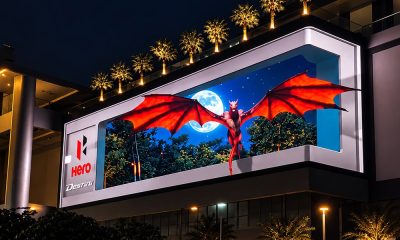
Hero Destini brings ‘The Dragon’s Test’ to life through 3D anamorphic DOOH

Puma becomes PVMA for PV Sindhu

HOCCO’s Aamchi campaign brings mango tree to Ahmedabad

Blinkit in association with Kinetic India goes all Bollywood

Acclaimed Actor Manoj Joshi to deliver an inspirational address at OAC 2024

Zepto’s Fast 10 Minute Delivery Saves the Day for Game Night in Ahmedabad!

‘Let’s create an empathetic space for women’

‘It won’t just be a man’s world anymore’

‘We’re actively exploring acquisitions and working to increase our inventory’

A habit of success at Prakash Arts

‘OOH is an important channel to connect with corporate audiences’

Video Editor
Job Description: Editing videos of editorial interviews, in-house events, video podcasts, promotional videos and others based on team brief Planning...
Content Editor-Writer
Job Description: Editing daily news copies and magazine articles Writing industry research and interview based articles and client focused content...


Sales Manager (Amritsar, J&K, Chandigarh, Mumbai, Vadodara, Udaipur, U.P.)
Orango has been involved in creating, building, reviving and growing brands. Orango builds powerful connections with their customers & people...

Sales Executive
Established B2B Media and Events Group VJ Media Works is looking for sales executives
Digital Marketing/Social Media Executives
Established B2B Media and Events Group VJ Media Works is looking for the following: Digital Marketing/Social Media Executives Location: Mumbai/Bangalore...

Sales Manager – AdZ (Digital Advertising)
Estontec Group’s fast-growing adtech brand AdZ is hiring a Sales Manager to drive digital media sales and client growth. This...
Onboarding Specialist
Join Estontec Group’s transit media brand BrandonWheelz as an Onboarding Specialist, managing campaign execution, vendor coordination, and media planning across...


Operation Manager
Company Description: BajuGali an Advertisement Company is a leading firm specializing in advertising and marketing services. We provide innovative solutions...

Goldmedal Electricals launches transit OOH campaign in Mumbai
The campaign showcases Goldmedal’s flagship portfolio including its Air Modular Switches, the advanced Smart Home Automation & Sensor series, LED...
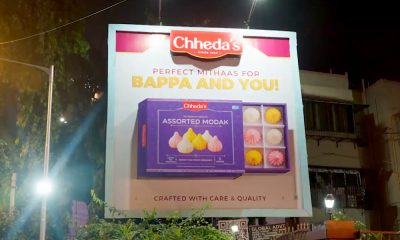

Chheda’s brings its Modak box to life with kinetic OOH for Ganesh Chaturthi
The execution features a large 3D Chheda’s Modak box built into the billboard, with the box sliding in and out...


BRND.ME’s perfume brand Villain puts its Gold Revolver on the move across Bengaluru
The activation covered key locations including Russell Market in Shivajinagar, Vidhana Soudha and Koramangala.
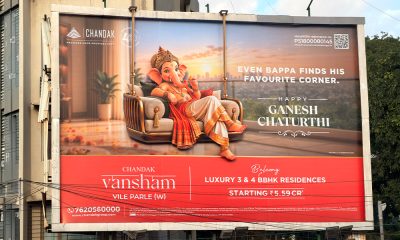

Chandak Vansham’s swinging Ganpati OOH campaign in Mumbai
The campaign is executed by Media Buying House
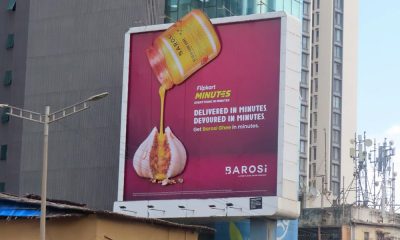

Flipkart Minutes serves up Barosi Ghee in a larger-than-life OOH execution
Flipkart Minutes brings Barosi Ghee’s food proposition to life through a 3D-inspired billboard that makes the product and its promise...


Landsec and Ocean Outdoor build on the cultural resonance of Piccadilly Lights
Changes to the screen's format come into effect from January 2027, 10 years after Piccadilly Lights relaunched following a nine-month...


Royal Stag Boombox goes larger-than-life with anamorphic LED in Hyderabad
The campaign is conceptualised and executed by Coral Media
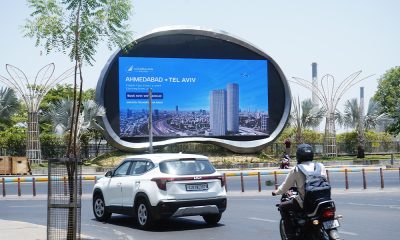

Times OOH Unveils ‘The Riviera’ in Ahmedabad
The screen is located at Sabarmati Riverfront on Ashram Road


Times OOH upgrades the Media Experience on Mumbai Metro Line 1
The move to 75-inch displays gives brand creatives significantly greater visual impact, while the enhanced brightness ensures vivid, true-to-life imagery...

Broadsign released 2026 programmatic DOOH trends report
Drawing on full-year 2025 and Q1 2026 internal transaction data, the report, surfaces useful signals about what today’s buyers value...
-
 Insights
Why is India’s digital signage market not looking beyond the screen?
-
 Campaigns
Hero Destini brings ‘The Dragon’s Test’ to life through 3D anamorphic DOOH
-
Campaigns
Chandak Vansham’s swinging Ganpati OOH campaign in Mumbai
-
Campaigns
BRND.ME’s perfume brand Villain puts its Gold Revolver on the move across Bengaluru