Insights
“The screen is only the beginning; the experience is what matters”
In an interview with M4G, Abhinav Nagireddy, Founder and Managing Director, Iconic by One Vision, discusses the company’s growing DOOH network, its focus on premium mall environments, the technology powering its large-format screens, and the thinking behind building a more measurable and creatively flexible DOOH proposition.

DOOH is steadily moving beyond the conventional idea of a screen simply displaying an advertisement. As brands look for environments where technology, location and creative execution can work together, premium malls and high-footfall commercial spaces are emerging as important destinations for digital media. Iconic by One Vision is building its proposition around this shift, with a growing network of large-format digital screens across key retail and commercial destinations in India. The company recently took this approach to a new scale with the launch of a 586.14 sq. m. 8K L-shaped display at SAS iTower in Nanakramguda, Hyderabad, its biggest installation to date and one that also brings anamorphic 3D capabilities to the city.
With screens already present across Bengaluru, Bhopal, Jaipur, Thiruvananthapuram and Bhubaneswar, the Hyderabad installation marks another step in the company’s national expansion. In an interaction with M4G, Abhinav Nagireddy, Founder and Managing Director, Iconic by One Vision spoke about the thinking behind building the network, the technology and infrastructure involved, and where he sees premium DOOH heading next.
Iconic by One Vision is building its network around this opportunity, with screens placed across premium retail environments in multiple cities. The network currently spans locations including Meenakshi Mall, Elements Mall and GT World Mall in Bengaluru, WTP Mall in Jaipur, VR Mall in Chennai, DN Regalia Mall in Bhubaneswar and DB Mall in Bhopal. In Hyderabad, the company has a presence across Hitech City Metro Mall, Panjagutta Metro Mall, Musheerabad Metro Mall and Errum Manzil Metro Mall.
For Abhinav, the proposition is not simply about increasing the number of screens. It is about selecting environments where the physical space, audience and technology can come together to create a stronger advertising opportunity.
“We are looking at the entire environment around the screen,” Abhinav explained. “The location, the audience, the format and what a brand can create on that particular screen all become important. A screen should not be treated as an isolated piece of inventory.”
Building around the location
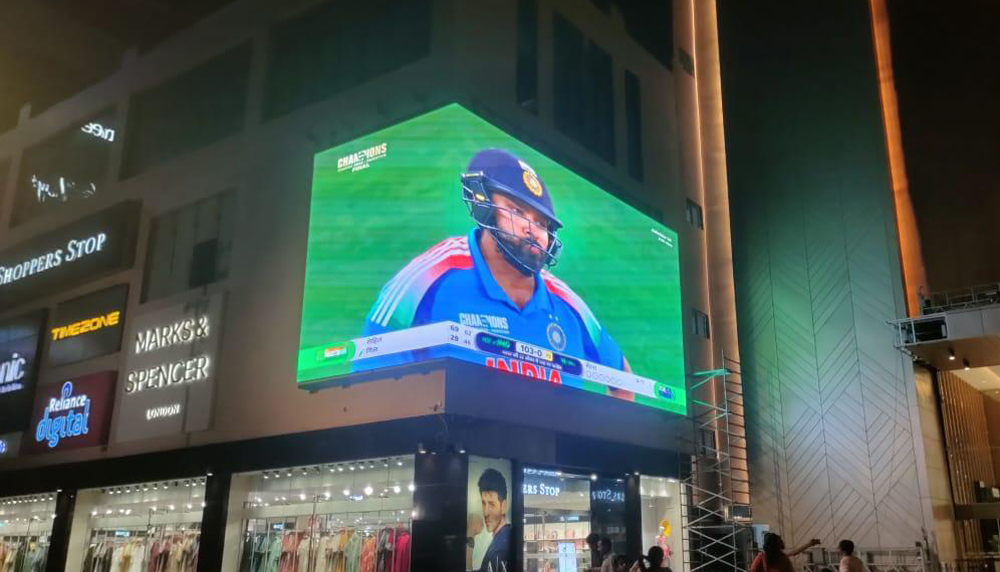
The network has been designed around high-footfall environments, with screens positioned across different parts of the consumer journey within malls. Entrances, atriums, food courts and large facade opportunities offer different levels of visibility and allow brands to use formats suited to the architecture.
This has also influenced the kind of screens being deployed. Alongside conventional digital displays, Iconic by One Vision is working with curved, circular, 3D and anamorphic formats, giving advertisers greater scope to build creative around the physical characteristics of the screen.
At GT World Mall in Bengaluru, for instance, the company has an anamorphic screen located on the fifth level. Its positioning gives it visibility not only to mall visitors but also to audiences outside the property, creating a larger canvas for brands.
Abhinav said the intent is to use each location according to its potential rather than applying the same format or communication approach everywhere. “Every location has its own character. The screen has to work with the space around it, and that is where we see the opportunity to create something more impactful for brands,” he said.
The growing role of anamorphic and 3D
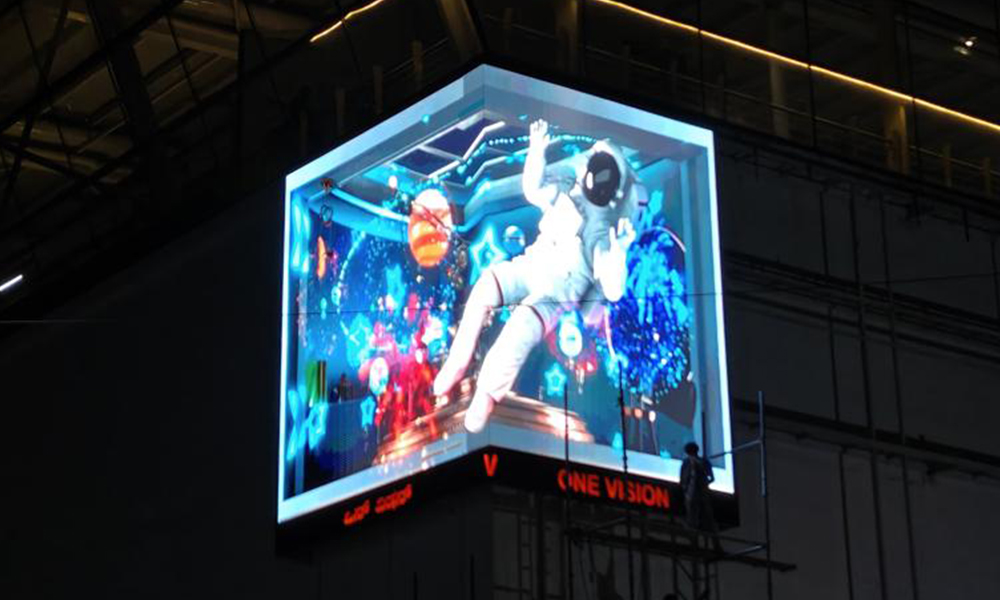
One of the most visible shifts in DOOH has been the rise of anamorphic and 3D content. For Iconic by One Vision, the technology is also becoming an opportunity to rethink how brands approach creative development.
The company has worked with brands across categories, including Google Pixel and Nissan, while also seeing interest from real estate and other sectors where products can lend themselves to immersive visual storytelling.
According to Abhinav, real estate in particular presents an interesting opportunity because properties can be visualised in ways that conventional advertising formats cannot easily replicate.
“We are seeing a lot of interest from real estate brands because there is so much that can be done with the product,” he said. “You can make a room appear to come out of the screen, or take the viewer through different parts of a property. It allows the product itself to become part of the creative.”
The company also works with advertisers that may not already have 3D or anamorphic assets, helping develop content specifically for its screens. This brings the media and creative conversations closer together, particularly for brands looking to make the most of a non-standard format.
Behind every large screen is a complex operation
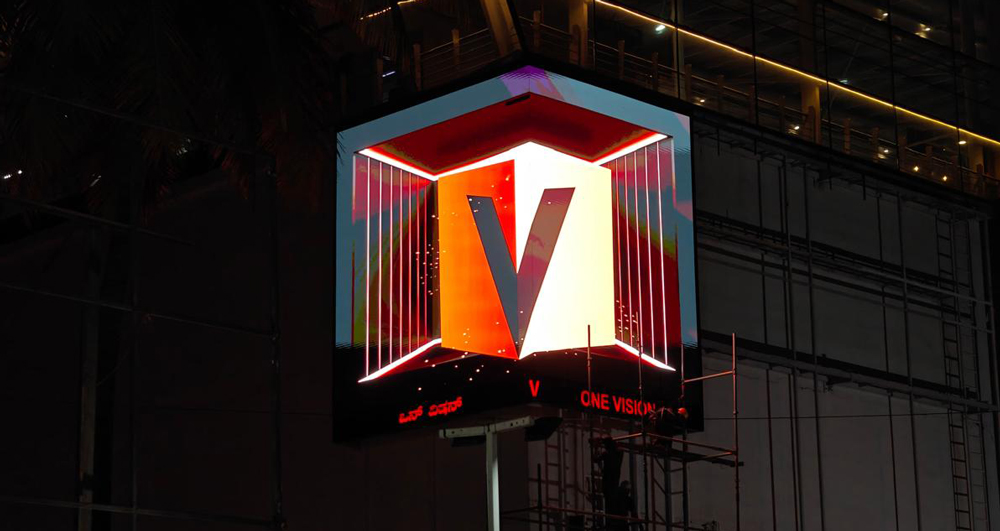
While the finished product is designed to look seamless, building large-format digital infrastructure inside or around existing properties involves considerable engineering and operational work.
Abhinav pointed to the installation at Meenakshi Mall as one example. The existing glass facade could not accommodate the weight of the screen, requiring sections of the structure to be modified and an iron framework to be built before the screen could be installed.
“The installation is actually one of the biggest parts of the business,” Abhinav said. “It is not just about getting a screen and putting it up. You have to look at the structure, fabrication, engineering, permissions and how the screen integrates with the building.”
The company has consequently developed its own fabrication capabilities rather than relying entirely on external partners. This gives it greater control over the installation process and allows it to customise structures according to individual locations.
The scale becomes even more apparent in projects involving larger screens. In Hyderabad, the company undertook a significant installation that involved procurement, structural work, building approvals, traffic-related permissions and coordination with multiple stakeholders.
For a medium that increasingly sells impact through scale and technology, the infrastructure behind the screen becomes as important as the screen itself.
Selecting technology beyond specifications
Iconic by One Vision has also taken a hands-on approach to selecting its hardware. Abhinav said the team travelled to China and evaluated multiple manufacturers before selecting its technology partner.
Rather than relying only on specifications, the team physically tested different screens before making the decision.
“We tested the screens ourselves because there can be a big difference between what is written in a specification sheet and what you actually see on the screen,” Abhinav noted. “We looked at quality, efficiency and the kind of support available before finalising the technology.”
The company has also built redundancy into its maintenance process, keeping spare modules at locations so that faulty components can be replaced without having to wait for fresh equipment to arrive from another market.
For advertisers, particularly premium and global brands, uptime and consistency are critical. A technically advanced screen loses its value if it cannot deliver the required quality throughout a campaign.
Keeping the inventory open to agencies
While premium DOOH networks can sometimes develop around exclusive agency relationships, Iconic by One Vision has chosen a different route.
Abhinav said the company wants its inventory to remain accessible to agencies across the market rather than restricting it to one partner.
“We don’t want to limit ourselves by giving exclusivity to one agency,” he explained. “Keeping the inventory open allows us to work with different agencies and brands and gives us the flexibility to take on the right opportunities.”
The approach has helped the company work with both national brands and local advertisers. While larger brands are drawn to the scale and technology of the screens, local categories such as real estate are also finding relevance in the ability to create high-impact communication within premium environments.
Moving towards measurable DOOH
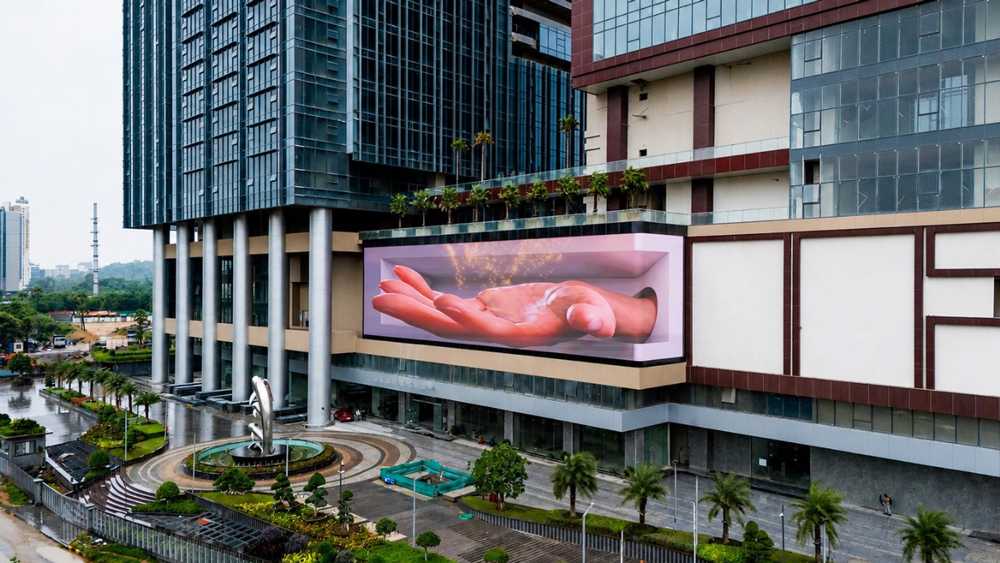
As DOOH becomes more sophisticated, measurement is increasingly becoming part of the conversation. For Iconic by One Vision, the next stage involves giving advertisers a clearer understanding of the audiences being exposed to its screens.
The company is exploring audience measurement through external technology partners, including approaches that use smartphone signals and other data points to understand movement and potential exposure around its locations.
“We believe measurement has to become part of the product,” Abhinav said. “A brand should be able to understand not only where its campaign appeared, but also the kind of audience and movement around that location.”
The company also tracks mall footfall data, which can provide additional context for campaigns running within or around retail properties.
This becomes particularly relevant as advertisers increasingly look to compare DOOH with other measurable media channels. For premium DOOH, the challenge is not only demonstrating visibility but translating that visibility into audience intelligence and eventually business outcomes.
A premium proposition comes with a different value equation
The technology, infrastructure and locations also place Iconic by One Vision firmly in the premium end of the DOOH market.
The company operates its screens through fixed advertising slots, with campaigns running within defined loops and operating hours. Its larger screens and high-visibility locations command a premium, but Abhinav believes the value proposition needs to be viewed beyond a simple comparison of media rates.
“The price can look high if you compare it directly with conventional DOOH,” he said. “But once you consider the location, the size of the screen, the audience and the creative possibilities, you are looking at a very different product.”
This positioning is particularly relevant for campaigns where the objective is not simply to achieve a certain number of impressions but to create a visible brand moment in a premium environment.
Looking beyond malls
While malls form the foundation of the current network, Iconic by One Vision is also exploring opportunities outside traditional retail environments.
The company is looking at potential projects in other high-footfall public spaces and has been exploring government-led opportunities, including prospective installations in Gurgaon and Assam.
For Abhinav, this expansion is part of a broader ambition to take the company’s approach to DOOH into environments where location and technology can create a differentiated media proposition.
“We are not looking at this as just a business of putting up screens,” Abhinav concluded. “We want to build a network where the location, technology, content and audience all work together to create something valuable for the brand.”
As DOOH continues to evolve, the next phase may therefore be less about how many screens a network owns and more about what those screens can enable. For Iconic by One Vision, that means combining premium locations with increasingly sophisticated formats, stronger creative possibilities and a growing focus on measurement.