Insights
From billboard to school pouch: How Eco Media Solutions and KDS are closing the loop on OOH waste
Dr. Saurabh Choudhary, CEO of Eco Media Solutions, and Santosh Nair, Group Director and CEO of Kromodyne Digital Solutions, are doing something unique and meaningful in the OOH industry — giving billboard prints a life after the campaign ends,and turning them into something that matters.

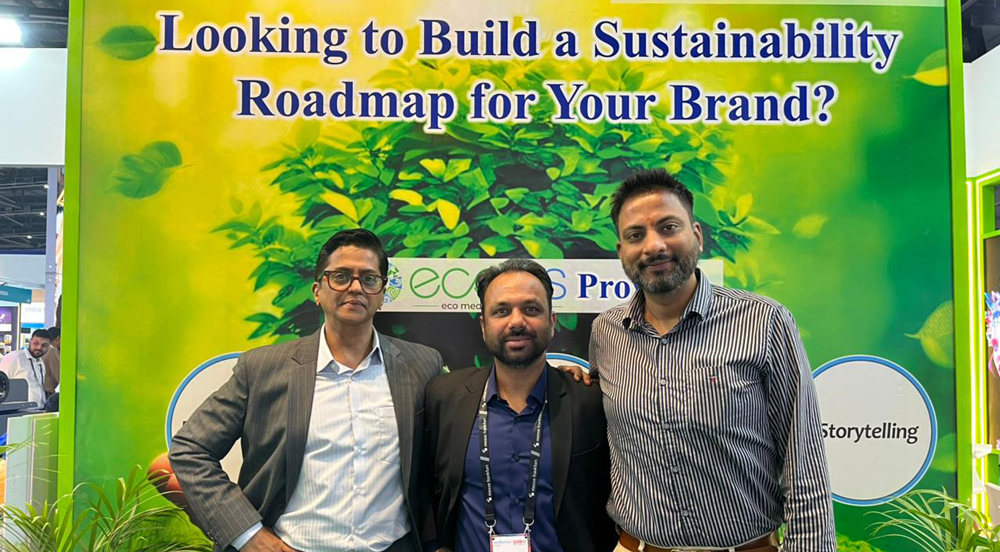
Every OOH campaign ends the same way. The creative comes down, the print is rolled up, and somewhere, in a landfill, in a corner of a warehouse, on the side of a road, it sits. Slowly degrading. Going nowhere. For decades, this has been the quiet, unacknowledged reality of an industry built on visibility. Nobody talked about what happened after. Nobody had a plan.
Saurabh Choudhary did not accept that. And what he has built, in partnership with Santosh Nair and Tribes Communication, is not just a sustainability initiative. It is an entirely new way of thinking about what an OOH campaign can do, before it goes up, while it runs, and long after it comes down.

The problem nobody was measuring
The starting point for Eco Media Solutions was a number from the Global Media Sustainability Framework: 2 to 4% of global carbon footprint comes from media and advertising activities. “We thought, we will start with a small solution to resolve this 2 to 4%,” Saurabh says. What emerged was a platform, currently patent-filed and in development, that will calculate the carbon footprint of an entire media campaign. Not just OOH. Everything. TV, digital, activation, retail, events. Every medium, every rupee spent, every tonne of CO2 produced. Eco Media Solutions already calculates carbon footprints for campaigns today, but the full subscriber-facing tool, where a brand inputs its annual square metres and gets a complete carbon report, is being built out as the next step.
But calculation alone was never the point. “Calculation is not just important by itself. It can give you the idea of how much impact you are doing to the environment. But then how to reduce it?” That question led Saurabh to Santosh and KDS, Kromodyne Digital Solutions, who had already been working on something the OOH industry had largely ignored: a credible, recyclable substitute for PVC.
The material that changes everything
Traditional OOH printing uses PVC. It is cheap, it is durable, and it is a disaster environmentally. PVC cannot be meaningfully recycled. It sits in landfills. It leaches toxins. It is health hazardous not just for the environment but for the workers handling it. And the OOH industry produces approximately 18,000 tonnes of it every single month. “Sustainability in OOH is talked about. It doesn’t exist. It’s not in practice,” Santosh says. “We are bringing it into existence.”
The alternative that KDS developed is polyethylene, PE. The material difference alone is significant. PE is lighter, making it easier and safer for mounters to handle on site. It does not tear as easily as PVC. And critically, it can be recycled. But the innovation goes further than just the material. The printing process for PE does not require the infrared heating that traditional solvent printing demands. “We removed IR out of the equation. This particular print does not require a heater. It cures purely on air,” Santosh explains. For printers running five machines, electricity is typically their single biggest operating cost. This process eliminates that cost entirely, and eliminates the VOC emissions that make solvent printing environments hazardous for the workers standing at those machines every day.
The next step, already in testing, is a VOC-free solvent ink. “When I say VOC-free, it is not 100% VOC-free, but the content is comparable to eco-solvent. The material with VOC-free ink and no heater is a big thing, especially for the labourer or the printer who is actually standing on that machine every day,” Santosh says.
What Wonder Cement’s workers now wear to work
The Wonder Cement campaign is the story that cuts through all the theory and makes this real.
Wonder Cement ran an OOH campaign on static billboards using PE material. When the campaign ended, Eco Media Solutions collected every single print off the sites. The material went to a recycling facility. What came back were helmets, safety helmets, made from the recycled billboard prints of Wonder Cement’s own campaign, distributed to the workers at Wonder Cement’s own factory.
Think about that for a moment. A company advertises on a billboard. The billboard comes down. The material is transformed. And the people who make that company’s product are now safer because of it. The campaign did not end when the print came down. It completed a circle, one that connected a brand’s public communication directly to the wellbeing of its own workforce.
Pens, pouches, and CSR
The Nivea campaign took the same principle and gave it a different, equally powerful destination.
For Nivea India’s Care Beyond Skin initiative, OMD India came together with Eco Media Solutions and Tribes Communication to reimagine what responsible media could look like. The entire OOH campaign was printed on PE. The prints ran, the campaign delivered its visibility. When it came down, the material was collected, recycled, and upcycled into school essentials, pens and pouches, for children who needed them most. The initiative was named Nivea Study Buddy.
From measuring the campaign’s carbon footprint to delivering a comprehensive sustainability report, every step was built around accountability. “Instead of letting post-campaign outdoor materials go to waste, the team chose circularity,” as Eco Media Solutions describes it. “Because when media is planned with intention, it doesn’t just create visibility, it creates value.”
The impact numbers are striking. For Nivea, 59% of their total carbon footprint across all media activities, TV, digital, social, and OOH, comes from OOH alone. By switching the campaign to PE and completing the recycling loop, Eco Media Solutions reduced Nivea’s campaign carbon footprint by 69%. Nivea responded by giving them the entire annual mandate.
Four pillars, one complete system
What makes this more than a good story is the architecture behind it. The model runs on four pillars working in concert: Tribes Communication for media execution and scale; KDS for the PE material and printing innovation; Eco Media Solutions for the carbon calculation, collection logistics, recycling, and storytelling; and the brands themselves, increasingly arriving not just through their marketing teams but through their CSR functions.
“For the first time ever, OOH is actually contributing to CSR activity, which was never there,” Santosh says. “It was just a marketing campaign. What was CSR getting out of it? Nothing. Now, CSR is the people who are actually going to drive this. They are going to direct the brand managers.” Saurabh is equally clear about where this is heading. “In the next one year, CSR is going to be more activated with us than the brand manager.”
This matters structurally because SEBI has now mandated that India’s top 1000 companies must move toward carbon neutrality, and marketing campaigns fall under scope 3 of that calculation. OOH, long treated as the third or fourth priority in a media plan, suddenly has a new and compelling argument to make at the boardroom level.
The data point that brings print back
There is a larger point here that Santosh makes with the quiet confidence of someone who has spent 35 years in this industry. The tug of war between static and digital OOH has been running for years. Static has been on the back foot. But something is shifting. More brands are returning to static, for the permanence, the constant visibility, the recall that comes from a medium that does not skip or scroll. And now, for the first time, static print comes back with something it never had before: data.
Carbon footprint data. Recycling data. Verifiable impact data that a brand can take to its CSR team, its board, and its investors. “Imagine, today, if OOH talks about a data point where they are saving X amount of carbon footprint over a year, you know what we are talking about. This is massive,” Santosh says. “Data in sustainability and environment was never there in OOH. Globally, we are going to make this the defining point. And I think, trust me, that is where print will come back. Not from anywhere else, but from the data point.”
The storytelling around each campaign is also deliberate. “It is important to motivate other brands,” Saurabh says. The videos showing the Wonder Cement helmets reaching factory workers, the Nivea Study Buddy pens and pouches reaching children, these are not just feel-good content. They are proof of concept. They show the brands, and every brand watching, that the loop can be closed. That there is a life after the campaign. That OOH, at its best, does not have to leave anything behind.
FOMO is already setting in
The market is responding faster than expected. Brands that have not yet adopted this model are starting to feel its absence. “In the last couple of months, many brands are feeling FOMO if they are not doing this,” Saurabh says. “They are reaching out to us. They are feeling that if you are not sustainable, you are missing something.” The team is already developing what they call an Eco Meter, a sustainability tag that brands could carry on their campaigns, signalling to consumers and competitors alike that their OOH is circular, accountable, and clean.
For Santosh, the moment is personal. “In the last 35 years of my career, there has not been a more encouraging factor in OOH than what it is today. Converting the hand-painting market to digital was a big thing in the 90s. But this, this is the next big thing that could ever happen in OOH.” He pauses. “And this journey has just started.”