Brand Insights
‘OOH is not for explaining, it’s for brand hammering’
Darshit Sanghani, Marketing Manager- Events and Branding of Odoo shares how the SaaS brand is using long-term billboards to build recall, why static outperforms DOOH, and how simplicity drives impact.

In a category dominated by digital-first marketing, Odoo is taking a different route, leveraging out-of-home (OOH) as a long-term brand-building tool rather than a performance channel.
For Darshit Sanghani, Marketing Manager – Events and Branding at Odoo, the role of OOH is sharply defined. “We don’t use OOH for lead generation or direct sales. It’s purely for brand awareness, so when our sales teams or partners speak to someone, the brand already feels familiar,” he explains.
Operating across more than 20 cities in India, Odoo’s OOH strategy is rooted in consistency and duration. Unlike typical short bursts of advertising, the brand invests in long-term site ownership, with campaigns running for a year or more, some even extending to two or three years in the same location.
“Outdoor is not a short-term medium,” Darshit says. “You can’t expect a recall in 15 days. Even 15 billboards for a year will work better than 100 billboards for a month.”
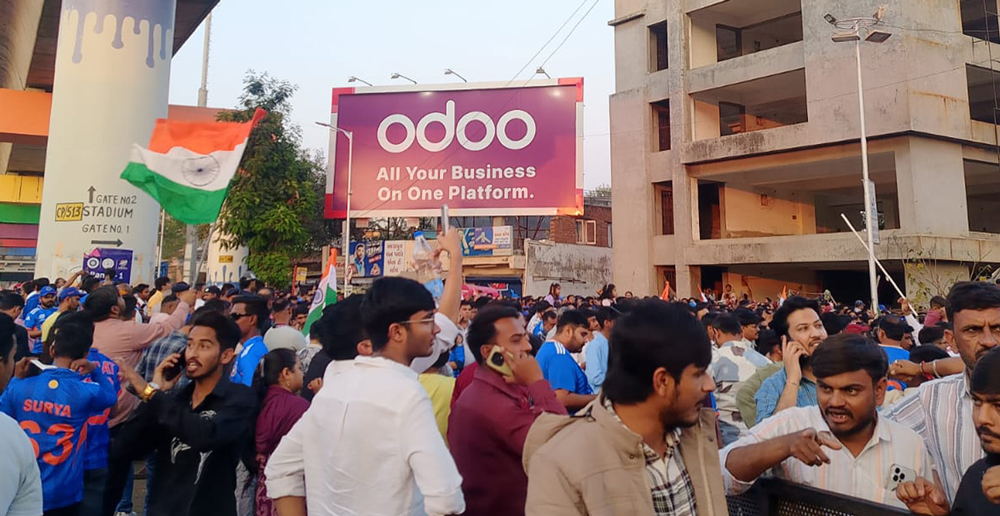
The focus is also highly strategic when it comes to location selection. Odoo prioritises high-frequency routes, airport roads, entry and exit points of cities, and major traffic corridors, ensuring repeated exposure to the same audience over time. This repetition becomes critical in building recall, especially for a category like ERP and business software, which isn’t instinctively associated with outdoor advertising.
Creatively, Odoo takes a deliberately minimal route. Its billboards are instantly recognisable, featuring the brand’s signature purple colour, logo, and just a few words. “Billboards should be designed by content writers, not designers,” Darshit notes. “You only have a few seconds. If you try to explain too much, you lose the audience.”
This simplicity is not limited to India. Odoo follows the same approach globally, adapting only the language while keeping the visual identity consistent. The objective is clear, build memory structures around the brand rather than communicate detailed product offerings.
While the brand has experimented with transit media, including metro wraps, bus branding, and cab campaigns across cities like Mumbai, Bangalore, Chennai and Hyderabad, the learnings have been clear.
“Transit gives visibility, but billboards give recall,” Darshit says. A metro wrap in Mumbai, for instance, generated strong organic traction, social media conversations and increased search activity. However, over time, the brand has leaned more heavily towards static formats.
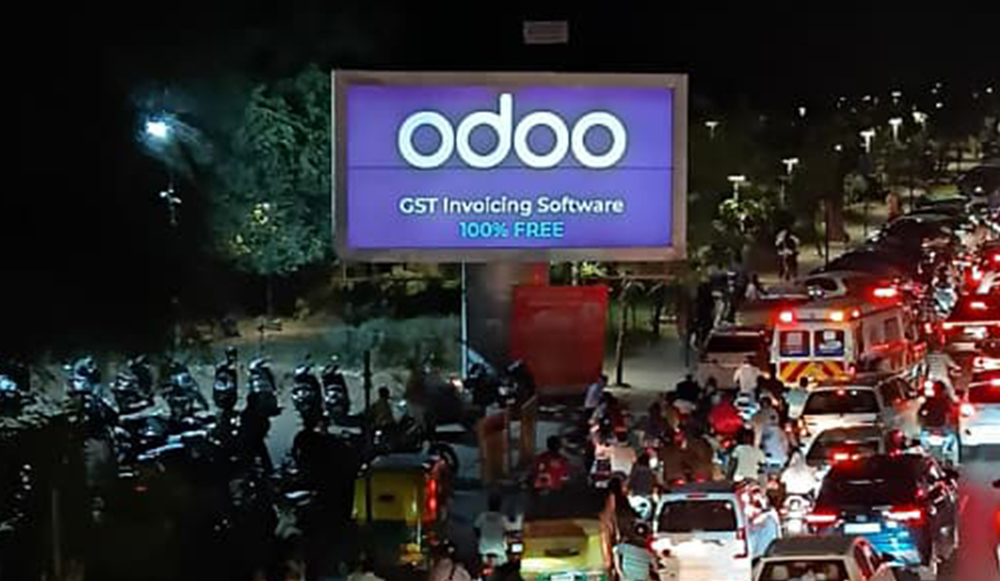
On the growing shift towards digital out-of-home (DOOH), Darshit remains sceptical. “If I’m paying a premium and still sharing the space with multiple brands, it doesn’t make sense. Static gives you ownership. With DOOH, you’re visible for just a few seconds.”
For Odoo, measurement is not about dashboards or real-time metrics, but about behavioural signals. The team tracks increases in organic searches, website visits, inbound queries, and feedback from its network of over 600 partners across India.
“When partners go to pitch Odoo and the client says, ‘I’ve seen your billboard,’ that’s when we know it’s working,” he adds.
With more than 300 sites live and a growing footprint across markets, Odoo’s OOH strategy is built on a simple but effective philosophy, consistency over clutter, clarity over complexity, and recall over explanation.
Read the full article in the May edition of Outdoor Asia Magazine.