
Ad Policies & Regulations
MMB’s new policy formalises coastal OOH, but raises the cost of entry
Maharashtra Maritime Board’s (MMB) new advertising regulations open up coastal inventory across formats, while introducing structured licensing, premium pricing, and stricter compliance norms


The Maharashtra Maritime Board (MMB) has introduced a comprehensive set of regulations governing advertising across its jurisdiction, formally opening up coastal and maritime zones as a structured out-of-home (OOH) medium.
Now, coastal OOH transitions from an unorganised, permission-led space into a regulated, monetisable, and scalable media ecosystem, aligned with formats like airports and metro networks. However, this shift comes with significantly higher costs and tighter controls.
Expanding the canvas: From hoardings to floatels
The new framework dramatically expands the scope of permissible formats.
In addition to traditional hoardings and unipoles, the policy enables:
- Digital and LED displays
- Banners, kiosks, posters, and standees
- Transit formats including vehicle wraps and parked media
- Aerial formats such as balloons
- Innovative formats across barges, vessels, and floatels
The regulation further classifies inventory into large, medium, and small formats, along with temporary and aerial advertising, bringing much-needed structure to planning and execution.
This effectively transforms coastal zones into a multi-format OOH ecosystem, rather than fragmented inventory pockets.
From permissions to a bidding economy
A key shift lies in the move from ad-hoc permissions to a formal licensing and bidding model.
- Advertising rights will be awarded through competitive bidding
- Advertisers must quote a premium over minimum license fees
- Contracts are governed through structured agreements, with tenures of up to 10 years
- Monthly payments, deposits, and fee escalation clauses are built into the system
This brings predictability and scale, but also introduces a more competitive and capital-intensive environment.
The cost factor: Coastal visibility now comes at a premium
While the policy unlocks new inventory, it also significantly raises the cost of participation. Under the new framework, digital advertising along Mumbai’s coastline is priced at around ₹1,000 per sq. metre, setting a new benchmark for this category.
Beyond this base rate, advertisers must also account for:
- Premiums through competitive bidding
- Security deposits and advance monthly payments
- Fabrication and installation costs, especially for marine formats
- Ongoing maintenance and compliance expenses
The regulations clearly outline a minimum license fee structure with premium escalation, reinforcing that coastal OOH is now a high-investment, long-term media play.
What was once opportunistic inventory is now positioned as premium media real estate.
Stricter compliance and accountability
The framework introduces strong governance across execution and operations:
- Mandatory approvals for every installation
- Compliance with ASCI guidelines
- Structural safety certifications and insurance requirements
- Strict enforcement, including removal of unauthorised advertisements
The licensee is responsible for end-to-end execution, from design and installation to maintenance and regulatory clearances, creating a single-point accountability model.
Aesthetic control and environment sensitivity
Given the sensitivity of coastal zones, the regulations emphasise:
- Clean, well-maintained installations
- Non-obstruction of public infrastructure
- Restrictions on objectionable or disruptive content
This ensures that coastal OOH evolves as a premium, experience-led medium, rather than cluttered advertising space.
What this means for the OOH industry
The MMB policy marks a dual shift for the industry:
- Expansion of a new, high-potential OOH frontier
- Elevation of cost, compliance, and operational standards
By introducing structured licensing, format classification, and bidding-led access, coastal OOH is now comparable to institutional media ecosystems.
However, the higher financial thresholds mean participation will likely be led by organised players with strong execution and capital capabilities.
From visibility to value
The transformation of coastal advertising reflects a broader industry shift. OOH is no longer just about presence, it is increasingly about structured, regulated, and premium media ecosystems. With Maharashtra’s coastline now formalised as advertising real estate, the opportunity is clear, but so is the message: Scale comes with structure, and visibility now comes at a price.

Daily Newsletter
Subscribe to receive the latest OOH
industry updates

Rohit Chopra of Times OOH joins Gujarat Talks OOH panel on infrastructure-led growth

Kolonkojoyini uses Maa Durga installation to highlight stigma faced by trafficking survivors

Hocco brings its East India debut to Kolkata streets with a pujo-themed campaign

Mantra Ads joins Gujarat Talks OOH as Associate Sponsor

US study finds OOH delivers $7.97 in marginal profit ROI as DOOH adoption triples

Puma becomes PVMA for PV Sindhu

HOCCO’s Aamchi campaign brings mango tree to Ahmedabad

District uses Samay Raina’s signature shirt to announce his live show

Blinkit in association with Kinetic India goes all Bollywood

Acclaimed Actor Manoj Joshi to deliver an inspirational address at OAC 2024

‘Let’s create an empathetic space for women’

‘It won’t just be a man’s world anymore’

‘We’re actively exploring acquisitions and working to increase our inventory’

A habit of success at Prakash Arts

‘OOH is an important channel to connect with corporate audiences’

Video Editor
Job Description: Editing videos of editorial interviews, in-house events, video podcasts, promotional videos and others based on team brief Planning...
Content Editor-Writer
Job Description: Editing daily news copies and magazine articles Writing industry research and interview based articles and client focused content...

Sales Manager (Amritsar, J&K, Chandigarh, Mumbai, Vadodara, Udaipur, U.P.)
Orango has been involved in creating, building, reviving and growing brands. Orango builds powerful connections with their customers & people...

Sales Executive
Established B2B Media and Events Group VJ Media Works is looking for sales executives
Digital Marketing/Social Media Executives
Established B2B Media and Events Group VJ Media Works is looking for the following: Digital Marketing/Social Media Executives Location: Mumbai/Bangalore...


Sales Manager – AdZ (Digital Advertising)
Estontec Group’s fast-growing adtech brand AdZ is hiring a Sales Manager to drive digital media sales and client growth. This...
Onboarding Specialist
Join Estontec Group’s transit media brand BrandonWheelz as an Onboarding Specialist, managing campaign execution, vendor coordination, and media planning across...


Operation Manager
Company Description: BajuGali an Advertisement Company is a leading firm specializing in advertising and marketing services. We provide innovative solutions...
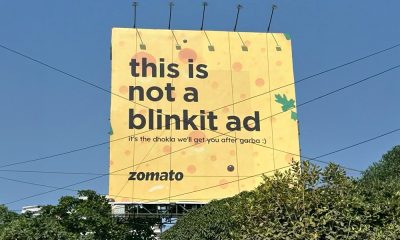

Zomato serves up a Garba-inspired OOH twist with a ‘not a Blinkit ad’ billboard
The billboard plays on Blinkit’s brand identity to promise a familiar Gujarati treat after Garba, using local food culture and...

Signpost India turns Bengaluru Metro into a canvas for Karnataka’s cultural heritage
The 16,000 sq. ft. visual experience brings Karnataka’s mythical forms and cultural heritage to life through advanced 8K Japanese projection...


Paramount Pictures takes ‘Street Fighter’ from street signs to larger-than-life OOH stunts
From fight-inspired street signage to a billboard featuring a larger-than-life stunt, Paramount Pictures turns the streets into an extension of...

‘Sunfeast Mom’s Magic Shines’ lights up the festivity with ‘Ei Pujo, Shine Koro!
The brand transforms Harish Park into ‘Kolkata’s Shiniest Pujo Pandal’, celebrating the light, creativity and festive spirit of Kolkata’s Durga...


Bingo! Tedhe Medhe brings ‘Abol Tabol’ to life through an immersive Durga Puja experience
At Rajdanga Naba Uday Sangha in Kolkata, the brand blends Bengali literary nostalgia with playful installations, interactive games and digital...

WOW Advertisement adds eight digital OOH screens across Ahmedabad and Surat
The expansion includes seven traffic LED screens across Ahmedabad and a 41 ft × 60 ft curved outdoor LED screen...

billups celebrates its anniversary by putting its people on billboard
The campaign is participating in fifteen locations across Asia, Europe and North America, including Belgrade, Amsterdam, Brussels, Berlin, Chicago. Portland,...
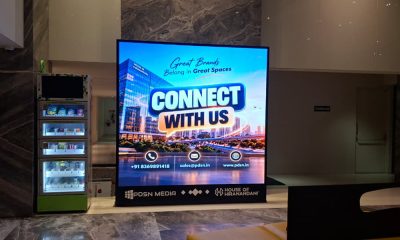

PDSN Media expands corporate DOOH network with new screens at Fulcrum
The new inventory comprises two 8×8 ft digital LED screens installed across Wing A and Wing B of the Mumbai...
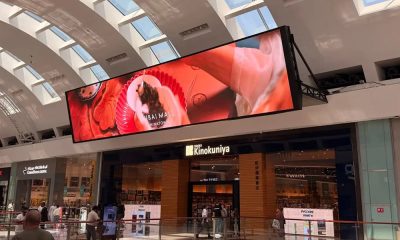

Dubai Mall expands its DOOH network with 1,100 sqm of LED displays
Emaar Properties has reportedly deployed approximately 1,100 sq m of LED displays across indoor and outdoor areas of Dubai Mall,...


Broadsign bags contract with Context Networks for screen network in 14 US states
Through the collaboration, Context Networks is connecting eligible CPMN™ inventory to the Broadsign Platform, the company’s complete, reliable Ad Server...
-
Campaigns
Zomato serves up a Garba-inspired OOH twist with a ‘not a Blinkit ad’ billboard
-
Creative Concepts
Signpost India turns Bengaluru Metro into a canvas for Karnataka’s cultural heritage
-

 Contracts & Investments
TVS Motor appoints Dentsu for integrated media mandate
-
 Industry News
US study finds OOH delivers $7.97 in marginal profit ROI as DOOH adoption triples