Insights
‘The gaps in tier 2 DOOH market is significant’
Dhananjay Singh Kushwah, Founder, FOMOSO, shares insights on building a hyperlocal DOOH network in Madhya Pradesh and what the market looks like for DOOH in tier 2 cities.

Walk into any well-known restaurant in Indore today and there is a good chance a FOMOSO screen is somewhere on the wall. Dhananjay Singh Kushwah, founder of FOMOSO, has spent four years building a DOOH network rooted entirely in Madhya Pradesh, starting with the city’s dining spots and expanding from there into corporate buildings, residential complexes, and transit locations across Indore and Ujjain.
We caught up with Dhananjay, founder of FOMOSO to understand how the network came together, what the MP market looks like, and where things are headed.
From banking to billboards
Before starting FOMOSO in 2022, Dhananjay worked as a banker with Kotak Mahindra Bank in Mumbai. The shift to media was driven less by a career plan and more by a simple observation he made after moving to Indore: the city’s residents eat out constantly.
“There are households in Indore that simply never cook dinner at home. Eating out is not an occasion here, it is a daily habit,” he says. Restaurants in Indore see long dwell times and repeat footfall, which made them a logical starting point for a screen network targeting local advertisers. He began placing screens in dining venues and built from there.
A network built on relevance
Rather than expanding purely on volume, Dhananjay applied a scoring model to decide which venues were worth entering. The core criterion was local recognition, a location had to be one that residents across Indore would already know by name.
The logic was straightforward. FOMOSO’s target advertisers were local businesses and MSMEs, the kind of clients for whom a screen in an unfamiliar venue delivers little value. “A person in Indore should recognise every place where our screens are. If someone has to ask where it is, the screen is in the wrong place,” he says. The model has since been applied across dining venues, corporate buildings, residential complexes, and transit locations in both Indore and Ujjain.
Building the hardware in-house
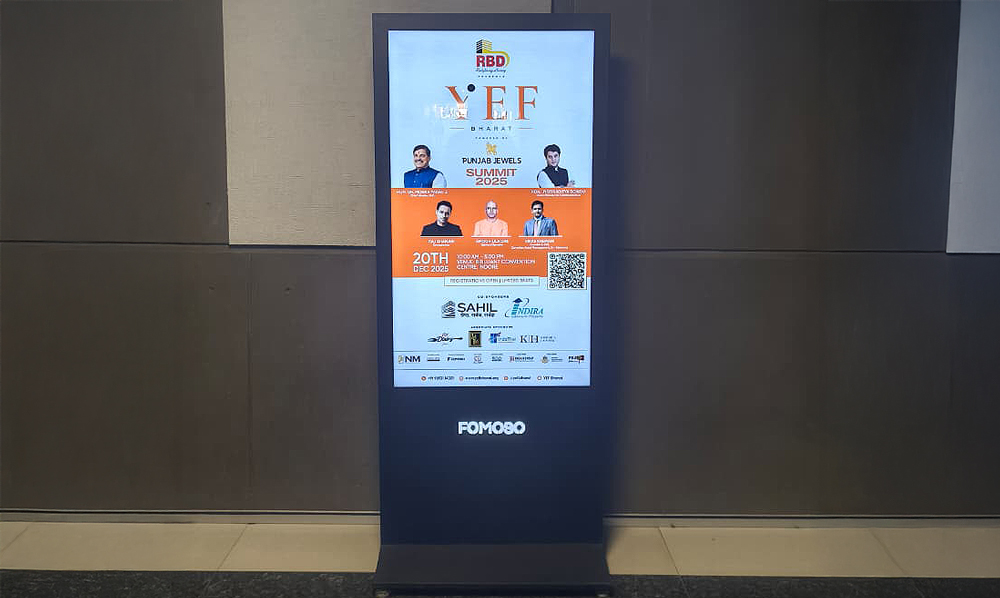
FOMOSO assembles its own screens rather than purchasing them ready-made. Premium displays are purchased, and the full installations are fabricated in-house. The decision came down to two things: quality control and customisation.
“Cheap hardware in an OOH network is a false economy. Screens that fail in the field damage client trust far more than the money saved on the front end,” Dhananjay says. On the customization side, brands with specific visual requirements can have screens built to those exact specifications, including backlighting and logo treatments, at a single location if needed. It is a service that most standardised networks do not offer.
From Zomato to the local jeweller
The client list at FOMOSO ranges from Zomato, Swiggy, Malabar Gold and Diamonds, Decathlon, BYD, Tata Motors, Orra Diamonds, Unacademy and Oppo to neighbourhood jewellers, coaching institutes, and single-outlet retailers. The network was set up to be accessible at almost any budget, with geographic targeting flexible enough to serve a brand operating out of one part of the city just as effectively as one trying to reach it more broadly.
“Our intent has always been to serve local businesses first. We built the network so that even a retailer with a limited budget can run a focused campaign in just the areas that matter to them,” Dhananjay says. The value proposition against traditional outdoor is simple: a prime static hoarding in Indore can cost upwards of Rs 2.5 to 3 lakh a month for a single site. Digital screens allow a client to direct that spend with considerably more precision.
A city that has not gone digital yet
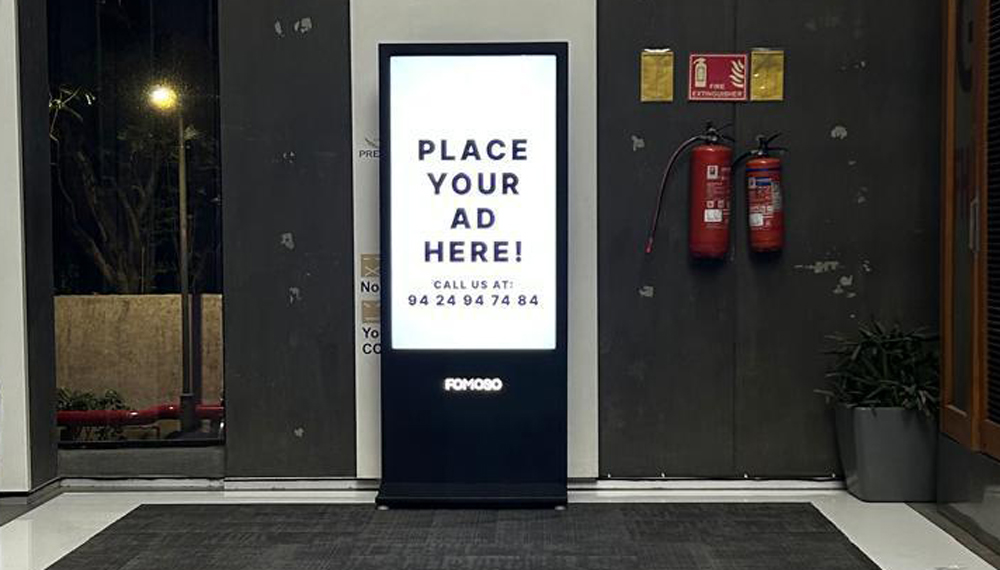
Outdoor advertising in Madhya Pradesh remains overwhelmingly static. Indore has no significant DOOH presence on its roads, and national media owners that operate in most large Indian cities are largely absent here. The options available to advertisers are limited and concentrated among very few players. “When national campaigns are being allocated across markets, Indore tends to come up around 13th or 14th on the list. That is just the reality,” Dhananjay says.
Local brands are the real buyers
The demand side of the MP market has its own dynamic. Walk past the billboards in Indore and national advertising accounts for the bulk of what is visible. Local brands, even established ones, are present via only unipoles. The economics make it difficult. A single static hoarding in a prime Indore location can cost Rs 2.5 to 3 lakh a month, a price point that works for national advertisers spreading cost across large campaigns, but not for the local jeweller or regional retailer. The result is that outdoor in MP has historically served national advertisers while local businesses have had no real entry point into the medium.
Indore and Ujjain as a connected market
Indore and Ujjain function as a connected corridor in terms of consumer movement and commercial activity, though the two cities draw quite different audiences. Ujjain’s footfall is driven largely by pilgrimage and tourism rather than retail or corporate activity. “The audience in Ujjain is distinct and the footfall is significant. It is not a market that advertisers have traditionally paid attention to, but the numbers are there,” Dhananjay says. With the Kumbh Mela two years away, that footfall is set to increase, and organised DOOH options in the city remain scarce.
The tier 2 gap
The situation in MP reflects a broader pattern across India’s tier 2 cities. DOOH infrastructure is thin in most of these markets, even as urban consumption and local business activity grow. The advertisers most active in tier 2 cities, local and regional brands, are precisely the ones that traditional outdoor has priced out. “The gap between what the market needs and what currently exists in tier 2 cities is significant. Most of these cities have never had a real DOOH option,” Dhananjay says. FOMOSO’s next moves, into Bhopal, Gujarat, and Uttar Pradesh, are an extension of the same bet it placed in Indore four years ago: that tier 2 cities represent the next phase of OOH growth in India, and that the window to build in them is still open.