
Insights
“Mere certification and parameters won’t fix it’
Lab Testing: The Way Ahead for LED Displays? continues with Gangasagar Amula, Director at Absen India, who shares his take on what testing in DOOH actually needs to mean, and why a standard alone won’t be enough to fix it.


The whole discussion on quality standards and testing of outdoor LED screens has many layers to it. In this conversation, as part of the M4G series on ‘Lab Testing: The Way Ahead for LED Displays?’ Gangasagar Amula, Director at Absen India, shares his insights on why even where a quality standard exists and a certification is issued for LED screens, it may not tell buyers as much as they think it does.
Gangasagar reiterates his point with one of the most commonly cited certifications on a DOOH spec sheet, IP rating, an internationally recognised scale that tells a buyer how well sealed a product is against dust and water. A screen rated IP65, for instance, is meant to withstand jets of water from any direction without letting moisture inside. On paper, it reads as a fixed, objective number, a screen either earns the rating or it doesn’t. Gangasagar’s point is that it isn’t quite that simple.
“The common way to test it is to spray water at the product from one direction, then rotate it 360 degrees and repeat. Once you open it up and there’s no water inside, the lab certifies it as IP65.” That’s a legitimate, widely accepted method, and it’s enough to pass in most labs.
Certification doesn’t convey the entire picture
Gangasagar says his own team tests the same rating differently, spraying water from every angle, including underneath the unit, before certifying it. But he’s clear that the point isn’t to hold up one company’s method as the right one, it’s that both approaches produce the same “IP65” label, with no way for a buyer to tell which version of the test a given product actually went through. “People take that certificate and go to market with a specification,” he says. “But the certificate doesn’t tell you how the water was actually poured.”
He points to brightness as a smaller-scale version of the same problem. A screen advertised at a given nit value can be tested to comfortably exceed that number, or tested just enough to scrape past it, and both approaches produce a spec sheet that reads the same way to a buyer. The figure on paper doesn’t say anything about how conservatively or how loosely it was arrived at. A buyer comparing two spec sheets showing an identical brightness figure has no way to know which manufacturer tested to a stricter bar and which didn’t.
Standards alone won’t close the gap either
Much of the current conversation around DOOH testing in India focuses on getting manufacturers to agree on a shared list of parameters, brightness, IP rating, thermal performance, that every screen should be tested against. Gangasagar doesn’t disagree with that goal, but he thinks it solves only part of the problem.
“Standards exist across the globe,” he says. “In India, every state almost behaves like its own market, with its own rules. There should be a standard, the OEMs and the media owners need to come together and agree on what that standard should be.” But agreeing on which parameters to test, in his view, still leaves open the question of how strictly each one should be tested, and that’s a gap a parameter list alone doesn’t close.
He’s blunt about what happens in that gap today. “Every OEM has the capability to build a good product,” he says. “It’s that some choose not to bring that product to market, they’d rather offer something cost-effective and substandard, because it helps them win the project on price. That devalues the entire system.”
Neutral certification, compliance are key
Gangasagar’s suggestion is that the industry needs an independent body, not any single manufacturer to define both the list of parameters and the method behind each one, so that a certification means the same thing regardless of who issued it.
even then, he’s careful to separate certification from compliance, and thinks India’s gap sits more in the second than the first. “More than certification, it should be the mindset of the people,” he says. “If you’re doing this kind of certification, it should be from a third-party unbiased lab that can give you the trust that a particular product is going to withstand the needs of the market.” Certification, in his framing, is only useful if it comes from a lab with nothing to gain from the result, and if manufacturers treat it as an ongoing standard to maintain rather than a one-time box to tick. “People shouldn’t do certification for the sake of doing it,” he says. “They should comply, and make sure the same standards are maintained at the end.” He also sees a role for advertisers here, not just media owners: if brands started asking for certified products before booking media, that pressure would filter down and make compliance a practical requirement rather than a voluntary one.









Daily Newsletter
Subscribe to receive the latest OOH
industry updates

Traya marks Dussehra with ‘Andhere Mein Teer Mat Chalao’ activation

Trident Group brings ‘Tree of Strength’ to Durga Puja with a sustainability-led activation in Kolkata

KISNA takes festive gifting nationwide with 300+ billboards featuring Shahid and Mira Kapoor

Dr. Falguni Vasavada, Professor of Marketing at MICA, to speak at Gujarat Talks OOH

Rohit Chopra of Times OOH joins Gujarat Talks OOH panel on infrastructure-led growth

Puma becomes PVMA for PV Sindhu

HOCCO’s Aamchi campaign brings mango tree to Ahmedabad

District uses Samay Raina’s signature shirt to announce his live show

Blinkit in association with Kinetic India goes all Bollywood

Acclaimed Actor Manoj Joshi to deliver an inspirational address at OAC 2024

‘Let’s create an empathetic space for women’

‘It won’t just be a man’s world anymore’

‘We’re actively exploring acquisitions and working to increase our inventory’

A habit of success at Prakash Arts

‘OOH is an important channel to connect with corporate audiences’


Video Editor
Job Description: Editing videos of editorial interviews, in-house events, video podcasts, promotional videos and others based on team brief Planning...
Content Editor-Writer
Job Description: Editing daily news copies and magazine articles Writing industry research and interview based articles and client focused content...


Sales Manager (Amritsar, J&K, Chandigarh, Mumbai, Vadodara, Udaipur, U.P.)
Orango has been involved in creating, building, reviving and growing brands. Orango builds powerful connections with their customers & people...


Sales Executive
Established B2B Media and Events Group VJ Media Works is looking for sales executives
Digital Marketing/Social Media Executives
Established B2B Media and Events Group VJ Media Works is looking for the following: Digital Marketing/Social Media Executives Location: Mumbai/Bangalore...


Sales Manager – AdZ (Digital Advertising)
Estontec Group’s fast-growing adtech brand AdZ is hiring a Sales Manager to drive digital media sales and client growth. This...
Onboarding Specialist
Join Estontec Group’s transit media brand BrandonWheelz as an Onboarding Specialist, managing campaign execution, vendor coordination, and media planning across...


Operation Manager
Company Description: BajuGali an Advertisement Company is a leading firm specializing in advertising and marketing services. We provide innovative solutions...


Kolonkojoyini uses Maa Durga installation to highlight stigma faced by trafficking survivors
The installation was conceptualised and brought to life by Tribes in collaboration with Sanlaap.
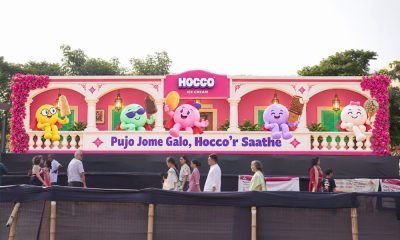

Hocco brings its East India debut to Kolkata streets with a pujo-themed campaign
To give the campaign a local feel and connect with people during Pujo, the brand used regional-language hoardings in Bengali.
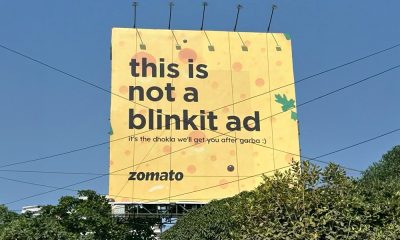

Zomato serves up a Garba-inspired OOH twist with a ‘not a Blinkit ad’ billboard
The billboard plays on Blinkit’s brand identity to promise a familiar Gujarati treat after Garba, using local food culture and...
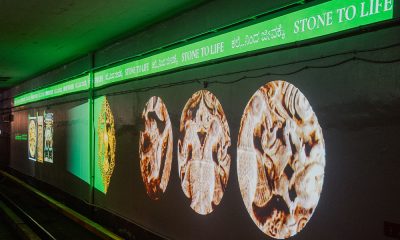

Signpost India turns Bengaluru Metro into a canvas for Karnataka’s cultural heritage
The 16,000 sq. ft. visual experience brings Karnataka’s mythical forms and cultural heritage to life through advanced 8K Japanese projection...


Paramount Pictures takes ‘Street Fighter’ from street signs to larger-than-life OOH stunts
From fight-inspired street signage to a billboard featuring a larger-than-life stunt, Paramount Pictures turns the streets into an extension of...

WOW Advertisement adds eight digital OOH screens across Ahmedabad and Surat
The expansion includes seven traffic LED screens across Ahmedabad and a 41 ft × 60 ft curved outdoor LED screen...


billups celebrates its anniversary by putting its people on billboard
The campaign is participating in fifteen locations across Asia, Europe and North America, including Belgrade, Amsterdam, Brussels, Berlin, Chicago. Portland,...
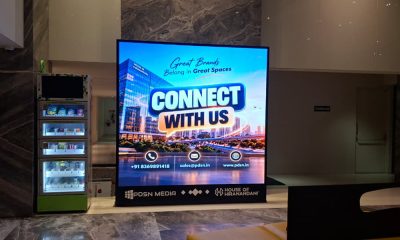

PDSN Media expands corporate DOOH network with new screens at Fulcrum
The new inventory comprises two 8×8 ft digital LED screens installed across Wing A and Wing B of the Mumbai...
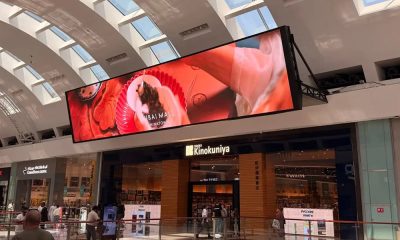

Dubai Mall expands its DOOH network with 1,100 sqm of LED displays
Emaar Properties has reportedly deployed approximately 1,100 sq m of LED displays across indoor and outdoor areas of Dubai Mall,...


Broadsign bags contract with Context Networks for screen network in 14 US states
Through the collaboration, Context Networks is connecting eligible CPMN™ inventory to the Broadsign Platform, the company’s complete, reliable Ad Server...
-
Campaigns
Zomato serves up a Garba-inspired OOH twist with a ‘not a Blinkit ad’ billboard
-
Creative Concepts
Signpost India turns Bengaluru Metro into a canvas for Karnataka’s cultural heritage
-

 Contracts & Investments
TVS Motor appoints Dentsu for integrated media mandate
-

 Industry News
US study finds OOH delivers $7.97 in marginal profit ROI as DOOH adoption triples